Search This Blog

Monday, February 4, 2019

The Future Of Translation


 Related image


1. From The Business Of Language To The Language Of Business

  article       
This article focuses on one specific function within the broader localization picture: translation. Across businesses worldwide, there is an increasing demand for translation, driven by:
  • an increase in demand for non-English languages,
  • increase in products and services from non-English countries reaching foreign markets,
  • an in vertical-specific translation use cases, and
  • a reduction of translation, driven by improvements in AI technology and the rise of cloud-based translation platforms. These lower costs support a growing “long tail” of businesses that can profitably offer services in multiple languages.
This article discusses this new future.

Related imageTranslation services at a turning point

Annual enterprise spending on translation services is expected to grow to US$45 billion by 2020, primarily driven by increasing globalization and an increasing amount of text being generated worldwide.
This growth is also being stimulated by new technology. Many organizations are using artificial intelligence (AI) in the form of machine translation (MT) to reduce the costs of translation. AI-enabled automated translation platforms like Google Translate, Microsoft Translator, and the recently released Amazon Translate have in the last 24 months taken a great leap forward in accuracy. This is for two reasons: one, they build on recent breakthrough improvements in neural machine translation (NMT) algorithms, and, two, they have access to a much larger amount of language data from search engines, social networks, and e-commerce sites.

AI and the end of translation jobs?

The recent acceleration in machine translation sophistication and reliability leads some observers to speculate that machines will essentially remove the need for expensive human translation even in the enterprise market, eliminating tens of thousands of jobs in product and service localization, publishing, marketing, and myriad other fields, even as the demand for translation explodes.

Translating the long tail

The number of languages and language pairs now handled by the most advanced translation platforms represents only a small fraction of the languages spoken across even the developed world. But translating content into languages beyond the 40 or so supported by the largest language service providers (LSP) and by enterprise software vendors has, to date, been difficult or impossible to cost-justify: for most companies, the cost and time required to add just one new language to a product has been measured in the millions of dollars and years of time.
Those barriers are about to be shattered by the combination of scale efficiencies enabled by cloud-based platforms and translator productivity improvements enabled by machine translation.
Top languages used on the Internet

https://www.digitalistmag.com/future-of-work/2018/05/17/future-of-translation-worldwide-06168565


2. language translation at multi-lingual congregations

Related image

the UN General Assembly work

At multinational events there are usually glass booths at the back of the auditorium where interpreters work in pairs, ideally switching off every 15-30 minutes. They use headphones to listen to what is being said, and simultaneously interpret it into a microphone that communicates with the headsets of people who need the interpretation. 
Some agencies have their own interpreters and some contract with translation companies. 

  • When there is no interpreter available for a language pair (say, an Azerbaijani speaker and a Spanish-speaking audience), chain interpretation is used: the Spanish interpreter will listen to another linguist's interpretation into a language he or she understands (perhaps English or Russian) and interpret from that into Spanish. This is not ideal, but is fairly common. 
  • Agencies that have their own translators/interpreters usually have their own testing and standards for hiring. Simultaneous interpretation is not usually validated, because of its on-the-spot nature, although the second interpreter may listen and provide written prompts to his or her partner or even interrupt in the event of an egregious error.   
  • However, a transcript or recording of an interpretation can be validated later by a second translator with a recording or speaker's text of the speech, or by anyone with an official translation of the speech. (For a graduate school paper, I once compared the official Spanish text of a speech by Fidel Castro to the UN with two English transcripts published in journals. The only significant error I found in the English transcripts was where the interpreter had rendered a phrase a bit awkwardly as "sea resources" and the transcriber misheard it as "key resources.")


Simultaneous interpretation usually runs between half a sentence and a sentence behind the speaker. It is tempting to stay closer than that, but the result is an overly literal interpretation that doesn't sound natural and is hard to understand.


(e.g., United Nations Language Careers, FBI Linguist/Translation Program). The American Translators Association offers professional interpretation and translation tests in many languages; an ATA Certification is highly respected and required by some agencies and translation companies. There are also official tests for state (e.g., Court Interpreters Program (CIP), For Interpreters)  and federal court interpreting (FCICE Home).

Thursday, January 31, 2019

all those reviews, kate

all those reviews we didnt read, kate

        readership   2015

       an astutely observed book written with a most enjoyable verve...

        readership   2013


 - The  press 


  • 2014 - The independent
https://www.independent.co.uk/arts-entertainment/books/reviews/watching-the-english-by-kate-fox-book-review-simplified-views-of-a-vibrant-race-9290978.html

  • 2004 - The Telegraph
https://www.telegraph.co.uk/culture/books/3616595/How-embarrassing-were-English.html

  • 2004 - The  Guardian
https://www.theguardian.com/books/2004/jul/24/highereducation.news1


 - The   vlogs 

  • 2015 - NONFICBOOKS  (05:58)   -VIDEO
      the wonderfully entertaining and fact-filled anthropological study of the English


  • 2015 -  EclecticBookReader  (05:02)   -Video


Tuesday, January 29, 2019

Kate Fox Presentations in February


February_ Sessions  25-30 min in class

  • When you are not presenting your chapter, you must read 3-4 pages random of the daily chapter and prepare a question to your "experts".


 Presentations  by 1 or 2 learners 
25-30 min in class + audience Questions
   plus language activities


PART TWO: BEHAVIOUR CODES

1. Home Rules  .............. Monday,   4
      Speakers         ________ Speakers
Jordi B                  -      Mercè  +  Laura

2. Rules of the Road .........   WED,   6
      Speakers         ________ Speakers
Albert                  -          Josep F        

 3. Work to Rule ............. Monday, 11
      Speakers         ________ Speakers
Maria P.             -     Carme + Aloma

4. Rules of Play   ...............  WED, 13
      Speakers         ________ Speakers
    Esteve         +                       Enric

5. Dress Codes   ............. Monday, 18
      Speakers         ________ Speakers
Sergio             -       Maria +Fina      

 6. Food Rules     ............ Monday, 25
      Speakers         ________ Speakers
Patricia  + Jordi   -   Raquel +Núria      

7. Rules of Sex    ...............  WED, 27
      Speakers         ________ Speakers
Joana +Emma     -      Ares +Judit          

8. Rites of Passage  ..... March  MON  4
      Speakers         ________ Speakers
Paquita                +                .....................     


9.  Collective debate: 


 Conclusion: Defining Englishness
Epilogue


Friday, January 25, 2019

oulipo and eunoia -WORDSMITHS


experimenting with the words....

 is it a great way to write when
you don't have any actual ideas?


  1)  La disparition, by G. Perec.

Raymond Queneau,
 Ouvroir de Litterature Potentielle 

There's a movement in France called Oulipo which explores such things. 

  • One of my favourite works from this school is the book by Italo Calvino where he wrote stories the plots and characters of which were entirely determined by laying out Tarot cards.
  •  The books are The Castle of Crossed Destiny and The Tavern of Crossed Destiny.


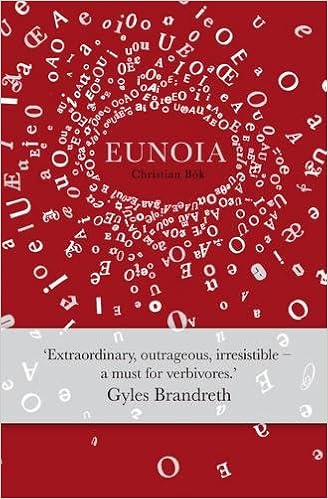
 2)  Eunoia  by C. Bok 


  • "Eunoia" means "beautiful thought" and is the shortest word in English to employ all of the vowels. Written over seven years—the same period of time it took Joyce to write Ulysses—"Eunoia" is a "universal lipogram," in that it restricts itself to the use of only one vowel per chapter (review)


from Chapter I
(for Dick Higgins)

Writing is inhibiting. Sighing, I sit, scribbling in ink
this pidgin script. I sing with nihilistic witticism,
disciplining signs with trifling gimmicks – impish
hijinks which highlight stick sigils. Isn’t it glib?
Isn’t it chic? I fit childish insights within rigid limits,
writing shtick which might instill priggish misgiv-
ings in critics blind with hindsight. I dismiss nit-
picking criticism which flirts with philistinism.


Christian Bok was definitely influenced by that Perec's A void, A no-E book., tranlated by G. Adair.


bonus_ A LONG STORY WITHOUT THE LETTER E_  Gadsby

this concept of not using "e" already been done by Ernest Vincent Wright with "Gadspy"? ...... what an amazing book. this is a 285 page novel that doesn't contain a single letter e. 

Wednesday, January 23, 2019

reader2 -session 6


Emerging Talk-rules: The Mobile Phone 

two quotes
  • "I have also noticed that many women now use their mobiles as ‘barrier signals’ when on their own in coffee bars and other public places, as an alternative to the traditional use of a newspaper or magazine to signal unavailability and mark personal ‘territory’. 
  • The mobile phone has, I believe, become the modern equivalent of the garden fence or village green. The space-age technology of mobile phones has allowed us to recreate the more natural and human communications patterns of pre-industrial society, when we lived in small, stable communities and enjoyed frequent ‘grooming-talk’ with a tightly integrated social network of family and friends.

 
aspects of ‘emerging’ mobile-phone etiquette that are even more blurred and controversial. 

  • There are, for example, as yet no agreed rules of etiquette on the use of mobile phones during business meetings. Do you switch your phone off, discreetly, before entering the meeting? Or do you take your phone out and make a big ostentatious show of switching it off, as a flattering gesture conveying the message ‘See how important you are: I am switching off my phone for you’? Then do you place your switched-off phone on the table as a reminder of your courtesy and your client’s or colleague’s status? If you keep it switched on, do you do so overtly or leave it in your briefcase? Do you take calls during the meeting? My preliminary observations indicate that lower-ranking English executives tend to be less courteous, attempting to trumpet their own importance by keeping phones on and taking calls during meetings, while high-ranking people with nothing to prove tend to be more considerate.
  •  Then what about lunch? Is it acceptable to switch your phone back on during the business lunch? Do you need to give a reason? Apologize? Again, my initial observations and interviews suggest a similar pattern. Lowstatus, insecure people tend to take and even sometimes make calls during a business lunch – often apologizing and giving reasons, but in such a self-important ‘I’m so busy and indispensable’ manner that their ‘apology’ is really a disguised boast. Their higher-ranking, more secure colleagues either leave their phones switched off or, if they absolutely must keep them on for some reason, apologize in a genuine and often embarrassed, selfdeprecating manner. 
  • There are many other, much more subtle social uses of mobile phones, some of which do not even involve talking on the phone at all – such as the competitive use of the mobile phone itself as a status-signal, particularly among teenagers, but also in some cases replacing the car as a medium for macho ‘mine’s better than yours’ displays among older males, with discussions of the relative merits of different brands, networks and features taking the place of more traditional conversations about alloy wheels, nought-to-sixty, BHP, etc.
  •  I have also noticed that many women now use their mobiles as ‘barrier signals’ when on their own in coffee bars and other public places, as an alternative to the traditional use of a newspaper or magazine to signal unavailability and mark personal ‘territory’. Even when not in use, the mobile placed on the table acts as an effective symbolic bodyguard, a protector against unwanted social contact: women will touch the phone or pick it up when a potential ‘intruder’ approaches. One woman explained: ‘You just feel safer if it’s there – just on the table, next to your hand . . . Actually it’s better than a newspaper because it’s real people – I mean, there are real people in there you could call or text if you wanted, you know? It’s sort of reassuring.’ The idea of one’s social support network of friends and family being somehow ‘inside’ the mobile phone means that even just touching or holding the phone gives a sense of being protected – and sends a signal to others that one is not alone and vulnerable

reader 2 -session 5


So what CLASS are YOU?

  •  A wickedly funny and all-too perceptive new book has the answer...         and it hinges on your favourite marmalade and what you buy at M&S
Daily Mail -article   19 April 2014          

What is Englishness? That is the question that social anthropologist Kate Fox set out to answer in her book Watching The English, which became an international bestseller. Now, ten years on, she has dug even deeper into our national foibles and eccentricities to update her study. The result is gloriously entertaining — and painfully accurate!
IT’S ALL ABOUT CLASS 
  • Most of the English would rather pretend that class ­differences don’t exist, or are no longer important, or at least that we personally have no class-related prejudices. ­Remember John Prescott’s assertion, before the 1997 election, that: ‘we are all middle class now’? He could not have been more wrong. Class still pervades all aspects of English life and culture, it’s just that we are painfully loath to admit it. 
  • So how do you pinpoint someone’s class in 21st century ­England? Certainly, foreigners are often bewildered. ­Occupation is no longer a guide to where you stand in the pecking order: these days, we judge social class in much more subtle and complex ways.  
  • And the truth is that all English people, whether they admit it or not, are fitted with a sort of social Global Positioning Satellite computer that tells them a person’s position on the class map as soon as he begins to speak. 
  • There are two main factors involved in calculating the class to which you, and others, belong: the words you use and, of course, how you say them. 

A) THE SEVEN DEADLY SINS 
Nancy Mitford coined the phrase ‘U and Non-U’ — referring to upper-class and non-upper-class words. And although some of her class-indicator words are now outdated, the principle remains. But she didn’t go far enough. While some words may simply separate the upper class from the rest, ­others more specifically separate the ­working class from the lower-­middle, or the middle-middle from the upper-middle. There are, however, seven words that the English uppers and upper-middles regard as infallible ­indicators. Utter any one of these seven deadly sins, and their on-board class-radar devices will start bleeping and flashing and you will be demoted to middle class, at best, and probably lower.

       1-6: Pardon  -Toilette - serviette -  Dinner/tea - settee - lounge

7: Sweet: The upper-middle and upper classes insist that the sweet course at the end of a meal is called the pudding.
‘Dessert’ isn’t quite as clear as it once was. Some American-influenced young upper-middles are starting to say ‘dessert’, and this is therefore the least offensive of the three — and the least reliable as a class indicator.


                   B)  SCHOOL NAME TAGS THAT SHOW THE         MIDDLETONS AREN'T SO POSH 


 C)  OTHER TELL-TALE WORD DIVIDERS
  • Posh: 
  • Perfume or  scent. 
  • Party time:  people go to a ‘do’?  a function?  a party? 
  • Portions or helpings. 
  • Patio:

D)  THE M&S TEST         
If you need to make a quick assessment of an Englishwoman’s social class, don’t ask about her family background, income, occupation or the value of her house (all of which would, in any case, be rude). Ask her what she does and doesn’t buy at Marks & Spencer. 

 E)   THE MARMALADE CLASSES  
Here’s an even easier test. Watch what someone puts on their breakfast toast. 
  • Dark, thick-cut Oxford or Dundee marmalade is favoured by  ....?

F)   WHAT CLASS IS YOUR CAR?

  • Still struggling? Try ­talking cars. 

Friday, January 18, 2019

Wsh_013_ Guff and other related expressions


Wsh_013_   selected Xpressions - KEY


Ch 1.3. HUMOUR RULES
           “At best a well-timed quip only raises a slight smirk”. 
Much of our humour is not obviously hilarious (no fits of laughter);  it is not often funny across cultures (sorry if you are a foreigner).

  • This heading can be read both in the straightforward sense of ‘rules about humour’ and in the graffiti sense of ‘humour rules, OK!’ The latter is in fact more appropriate, as the most noticeable and important ‘rule’ about humour in English conversation is its dominance and pervasiveness. Humour rules. Humour governs. Humour is omnipresent and omnipotent. I wasn’t even going to do a separate chapter on humour, because I knew that, like class, it permeates every aspect of English life and culture, and would therefore just naturally crop up in different contexts throughout the book. It did, but the trouble with English humour is that it is so pervasive that to convey its role in our lives I would have to mention it in every other paragraph, which would eventually become tedious – so it got its own chapter after all. 
  • There is an awful lot of guff talked about the English Sense of Humour, including many patriotic attempts to prove that our sense of humour is somehow unique and superior to everyone else’s. Many English people seem to believe that we have some sort of global monopoly, if not on humour itself, then at least on certain ‘brands’ of humour – the high-class ones such as wit and especially irony. My findings indicate that while there may indeed be something distinctive about English humour, the real ‘defining characteristic’ is the value we put on humour, the central importance of humour in English culture and social interactions. 

  • In other cultures, there is ‘a time and a place’ for humour; it is a special, separate kind of talk. In English conversation, there is always an undercurrent of humour. We can barely manage to say ‘hello’ or comment on the weather without somehow contriving to make a bit of a joke out of it, and most English conversations will involve at least some degree of banter, teasing, irony, understatement, humorous self-deprecation, mockery or just silliness. Humour is our ‘default mode’, if you like: we do not have to switch it on deliberately, and we cannot switch it off. For the English, the rules of humour are the cultural equivalent of natural laws – we obey them automatically, rather in the way that we obey the law of gravity. 


 A_ THE IMPORTANCE OF NOT BEING EARNEST RULE

  • At the most basic level, an underlying rule in all English conversation is the proscription of ‘earnestness’. Although we may not have a monopoly on humour, or even on irony, the English are probably more acutely sensitive than any other nation to the distinction between ‘serious’ and ‘solemn’, between ‘sincerity’ and ‘earnestness’.  
  • This distinction is crucial to any kind of understanding of Englishness. I cannot emphasize this strongly enough: if you are not able to grasp these subtle but vital differences, you will never understand the English – and even if you speak the language fluently, you will never feel or appear entirely at home in conversation with the English. Your English may be impeccable, but your behavioural ‘grammar’ will be full of glaring errors. 
  • Once you have become sufficiently sensitized to these distinctions, the Importance of Not Being Earnest rule is really quite simple. Seriousness is acceptable, solemnity is prohibited. Sincerity is allowed, earnestness is strictly forbidden. Pomposity and self-importance are outlawed. Serious matters can be spoken of seriously, but one must never take oneself  too seriously. The ability to laugh at ourselves, although it may be rooted in a form of arrogance, is one of the more endearing characteristics of the English. (At least, I hope I am right about this: if I have overestimated our ability to laugh at ourselves, this book will be rather unpopular.) To take a deliberately extreme example, the kind of hand-on-heart, gushing earnestness and pompous, Bible-thumping solemnity favoured by almost all American politicians would never win a single vote in this country – we watch these speeches on our news programmes with a kind of smugly detached amusement, wondering how the cheering crowds can possibly be so credulous as to fall for this sort of nonsense. When we are not feeling smugly amused, we are cringing with vicarious embarrassment: how can these politicians bring themselves to utter such shamefully earnest platitudes, in such ludicrously solemn tones? We expect politicians to speak largely in platitudes, of course – ours are no different in this respect – it is the earnestness that makes us wince.  
  • The same goes for the gushy, tearful acceptance speeches of American actors at the Oscars and other awards ceremonies, to which English television viewers across the country all respond with the same finger-down-throat ‘I’m going to be sick’ gesture. You will rarely see English Oscar-winners indulging in these heart-on-sleeve displays – their speeches tend to be either short and dignified or self-deprecatingly humorous, and even so they nearly always manage to look uncomfortable and embarrassed. Any English thespian who dares to break these unwritten rules is ridiculed and dismissed as a ‘luvvie’.  
  • And Americans, although among the easiest to scoff at, are by no means the only targets of our cynical censure. The sentimental patriotism of leaders and the portentous earnestness of writers, artists, actors, musicians, pundits and other public figures of all nations are treated with equal derision and disdain by the English, who can spot the slightest hint of self-importance at twenty paces, even on a grainy television picture and in a language we don’t understand. 

A1_ The ‘Oh, Come Off It!’ Rule
  • The English ban on earnestness, and specifically on taking oneself too seriously, means that our own politicians and other public figures have a particularly tough time. The sharp-eyed English public is even less tolerant of any breaches of these rules on home ground, and even the smallest lapse – the tiniest sign that a speaker may be overdoing the intensity and crossing the fine line from sincerity to earnestness – will be spotted and picked up on immediately, with scornful cries of ‘Oh, come off it!’ 
  • There have certainly been brave individuals who have campaigned for the rights and freedoms we now enjoy, but most ordinary English people now rather take these for granted, and prefer sniping, pinpricking and grumbling from the sidelines to any sort of active involvement in defending or maintaining them. Many cannot even be bothered to vote in national elections, although the pollsters and pundits cannot seem to agree on whether our shamefully low turnout is due to cynicism or apathy – or, the most likely answer, a bit of both. Most of those who do vote, do so in much the same highly sceptical spirit, choosing the ‘best of a bad lot’ or the ‘lesser of two evils’, rather than with any shining-eyed, fervent conviction that this or that party is really going to make the world a better place. 
  • Such a suggestion would be greeted with the customary ‘Oh, come off it!’ Among the young and others susceptible to linguistic fads and fashions, the current response might be the ironic ‘Yeah, right’ rather than ‘Oh, come off it!’ – but the principle is the same. Similarly, those who break the Importance of Not Being Earnest rule are described in the latest slang as being ‘up themselves’, rather than the more traditional ‘full of themselves’. By the time you read this, these may in turn have been superseded by new expressions, but the underlying rules and values are deep-rooted, and will remain unchanged.