Search This Blog

Monday, February 17, 2014

TAXES 2003 -Dude, where is my country?

Woo Hoo! I Got Me a  $33.000 Tax Cut

p159
Bush's tax cut

While the poor schmucks in the bottom half of the income bracket will keep about $100 a year, the richest 5 percent will be banking a whopping 50 percent of your tax cut.


as a result of Bush’s tax cuts from 39% to 35%, he gained $33,000 this year. Last year Moore was a high earner with his successful book and film and is a beneficiary of the tax cuts alongside Dick Cheney, who has a $85,924 tax cut this year and a promised $171,850 next year. 

 p160

Perhaps the genius move in this most recent tax cut is how you were able to tell the American public, "We're helping families with children who will receive immediate relief." The only problem was, you and the Republicans saw to it that the bill excluded 12 million children whose parents make between $10,000 and $26,000 a year-including one million children in military families. Those who needed the money the most were the ones who got the shaft. But, after all, how much did those low-income people contribute to the Bush campaign?
 PERSPECTIVE: 

2013 DEBT and GDP (USA and CHINA)
While property speculation has increased Chinese debts, business and household borrowing went up to 170% of GDP at the end of 2012. 
The equivalent proportion of GDP for the USA was 157%. Principal and interest repayments on business and household loans may absorb a third of GDP in the next decade
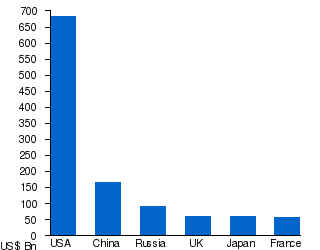
 Source :  SIPRI.org on US Military spending from wikipedia


But, which is the more realistic view of military spending? Which captures how Congress prioritizes spending? Which is more relevant to us?
Arguably, discretionary spending is most relevant to ordinary citizens, as we continue to suffer under rising unemployment, increased foreclosures, bankster bailouts, million dollar industry bonuses while the minimum wage remains below poverty, all amid a global financial crisis.
And what does that 58% of discretionary spending amount to?
 In 2010: $1,027.8 billion, or over a trillion dollars, according to Robert Higgs of the Independent Institute.


Vocabulary: Homie, Fella, homeboy, Dude, friend. 
What's the difference between 
Homie, Fella, homeboy, Dude, friend. 
Are those used to refer the same meaning?
 
"Friend" is standard English, and could be used in even the most formal of circumstances. For example, in the British Parliament a member might refer to the Prime Minister during a debate as "my right honourable friend."

Fella is the word "fellow", spelled in the way that many people pronounce it. Fellow is standard, but fella (spelled that way) would be slang. The use of the term does not necessarily indicate friendship (for example, the man who robbed the bank was a big muscular fella), although an old-fashioned woman who referred to a young man as "my granddaughter's fella" (or "feller", which is another phonetic spelling depending on dialect) would be saying that he was the granddaughter's boyfriend, or novio.

Homie, homeboy, and dude are all slang, and as such would be inappropriate for anything other than very informal conversation. Like most slang words, their appropriateness even in informal circumstances depends on fashion. When new slang terms arise, old slang words begin to sound dated and inappropriate in conversation.


Friday, February 7, 2014

the truth of fiction: House shows the way

Doctors at a clinic in Germany report that the TV show House (also known as House, M.D.) provided them with an unexpected diagnosis for a heart failure patient.
A patient with a mysterious set of heart symptoms left doctors in Germany stumped until they noticed some striking similarities to a case on the TV medical drama House. And it was not Lupus!
A 55-year-old man with severe heart failure was referred to a hospital in Marburg, Germany, to rule out coronary artery disease, a common cause of heart failure. 
  • He was almost deaf and almost blind, 
  • with fever of unknown cause, hypothyroidism, 
  • enlarged lymph nodes and several other symptoms. 
  • Both his hips had been replaced 
  • but otherwise his medical history was uneventful.

"Searching for the cause combining these symptoms — and remembering an 2011 episode of the TV series House, which we used for teaching medical students  — we suspected cobalt intoxication as the most likely reason," wrote Dr. Juergen Schaefer of Marburg University Clinic Center for Undiagnosed Diseases
Emmy Nominations Snubs Surprises
Hugh Laurie starred as Dr. House in a medical drama that gave doctors in Germany clues to a case of mysterious cobalt poisoning. (Adam Taylor/Fox/Associated Press)
Though the bedside manner of the misanthropic, Vicodin-addicted Dr. Gregory House may leave little to be desired, fans of the series this fictional character lends his name to thrill at his Sherlock Holmes-like powers of deduction.
House is a hospital drama where self-contained episodes are based less around the interpersonal entanglements of a show like ER, or the slapstick medical comedy of Scrubs, and the only bad guys are the diseases Dr. House himself diagnoses.
Given this premise, the writers of the show most likely trawled endless medical encyclopedias to come up with a supply of increasingly obscure diseases to keep Dr. House occupied across the show's eight seasons.

So comprehensive is the range of pathologies on the show, that Prof. Juergen R. Schaefer, director of the Center for Undiagnosed Diseases in Marburg, Germany, runs a medical class in which he teaches students to diagnose rare diseases using the TV show.
This class has led Dr. Schaefer to be known as "the German Dr. House" in the German media. But Shaefer's unorthodox approach is no teaching gimmick. Indeed, Prof. Shaefer and his colleagues' detailed knowledge of the show has had some surprising results.

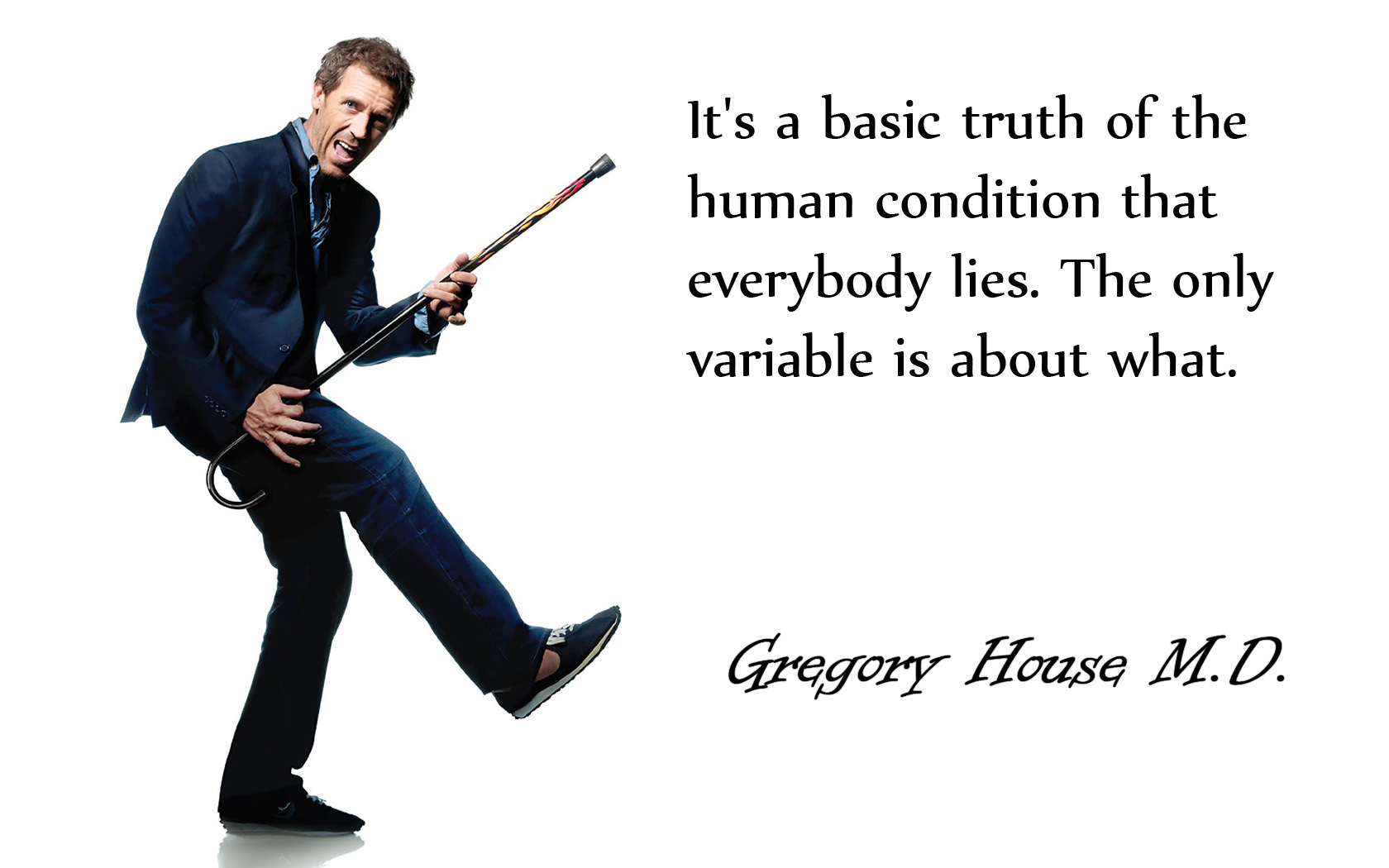
Snark QUOTES:

Snark: caustic, opinionated, critical rhetoric. (1) a witty combination of sarcasm and cynicism (2) directed at pop culture (3) delivered with a sort of blasé world-weary tone (4).
1# Want a better anagram for Gregory House? ‘Huge ego, sorry.’” – Season 3, “House Training”
2# “How come God gets credit whenever something good happens? Where was he when her heart stopped?”  – Season 3, “Human Error”
3# “Dying people lie too. Wish they’d worked less, been nicer, opened orphanages for kittens. If you really want to do something, you do it. You don’t save it for a sound bite.” – Season 2, “Hunting”
4# “Good news is, he’s running out of organs to fail.” – Season 4, “No More Mr. Nice Guy”
“Successes only last until someone screws them up. Failures are forever.” – Season 6, “Darkness”
5# Daniel: hypocrisy? You act like you don't care about anyone, but here you are, saving lives.
         House: Solving Puzzles. Saving lives is just collateral damages.


PS: Medical breakthroughs mean money! 
Science on KLH  -  Blue blood vaccines

Thursday, February 6, 2014

Traditional since 2013: from vintage iPads to Jurasic Wii

Time travel must be impossible, because it is capable of resulting in a paradox. 

You never know how soon is too late. 
Any time is no time: 
from a definite maybe, to an exact estimate. 
Now, you are informed!

In this entry, readers will explore at their own peril 
the commonly held belief that
 if anything bad can possibly happen in the future, 


it will and at the most inopportune time.

As the proverb goes:
A woman with one watch knows what time it is. A man with three Rolex is never sure.


1. My favourite paradox:
By the time one masters the exceptions, no one recalls 
the time rules to which they apply for our extinct life.

2. As an anticipated serendipity, a headline dawned on me:
Dawn of a new age: 
The first person to reach 150 is already alive


WelcometotheFutureofComputing
3. The best is yet to come
We already knew about genuine fakes,
authentic replicas, all natural artificial flavours, exclusive abundant poverty, ...
What else? 

But, be ready. Accidentally in purpose, we can purchase
our Customizable vintage iPad cases from Zazzle - 
Choose your favorite vintage iPad case design for your iPad 1,2,3,4 & Min

Customizable vintage iPad cases from Zazzle - 
Choose your favorite vintage iPad case design 
for your iPad 1,2,3,4 & Min
Brilliant stuff. I can almost see the Mad Men pitch for this.
Up to 64 Gigabytes – Gee Whiz!

4. Times flies, ... as in the movies.
The first ninety percent of the task takes ten percent of the time; 
the last ten percent takes the other ninety percent.

So, the sooner you fall behind, the more time you will have to catch up.

5. The first example of a "Groundhog Day" story  shows that experience is a wonderful thing. It allows you to recognize a mistake each time you repeat it: 
"Doubled and Redoubled", a short story by Malcolm Jameson that appeared in the February, 1941 issue ofUnknown. 
Accidentally cursed by a witch, the protagonist endlessly repeats a "perfect" day, including a lucky bet, a promotion, a heroically foiled bank robbery, and a successful wedding proposal.

6. Hard to believe: Daphne Selfe 

Supermodel face of TK Maxx at 85

24 August 2013 
Last updated at 19:15 BST
Former Vogue model Daphne Selfe, 85, has come back at the age of 70. 
She says she is busier now than ever.
Selfe from Baldock retired in the 1950s to raise her three children, but 15 years ago model, thought to be the world's oldest, decided to give it another go and is now part of the autumn/winter campaign for TK Maxx.


Annex: 
To read on Calendars and dates, east and west.

(Tis about Time to read the next entry...) 

Tuesday, February 4, 2014

non verbal communication: from Rajoy to Amay Cuddy


READing the body language:

  • Reading body language gives you insights into whether or not someone is telling the truth? True or False?
  • Would you like to know whether someone likes you or not, even before they say a word?
  • Do you want to know anyone's thoughts and feelings by capturing their body language?
  • Do you want to subsconsciously influence anyone... without even saying a single word?


Who does what?
Who looks where?

What can you read in these pictures?
to read about their body language at ELPERIODICO, click here 


to read about your eyes language at R. Phipps videos, click here 
=====
HOST: So up until this point, the kind of communication we've been hearing about is language, right. Words we speak or write or text - basically, things we have near-complete control over. 
But the thing is you don't have complete control over how you communicate because a big part of it happens unconsciously, which brings us to Harvard psychologist and professor Amy Cuddy, who teaches at the Business School.

NON VERBAL language: 

AMY CUDDY: At least half of communication is through nonverbal signals, and that includes - that includes:
 vocal cues like your pitch and 
how quickly you're speaking and 
how much range you show. 
So the language, I think, is at least smaller than most of us believe it is.
RAZ: Amy Cuddy studies nonverbal communication:
 the way you stand, 
how you move your hands, or
 the way you furrow your eyebrows. 
Things we do that send signals to other people about what we're like in that very moment. But she also studies how those same signals affect the way we think about ourselves. Take a listen to Amy Cuddy on the TED stage.


a lot of the science on this comes from the animal world: 
ONE: you are scared, 
 trying to stay hidden from predators:
They crunch up and  they get small.

TWO: they want to stand their ground, they go big.
Through postures that are open, that are expansive and that occupy space.
A) Wide stance, chest out, hands on hips.
B ) sitting, putting your feet up on your desk and
 leaning back, putting your hands behind your head 
 with your elbows out.

Monday, February 3, 2014

TED_Printing a human kidney - Anthony Atala in 3D


Let's Begin…

Surgeon Anthony Atala demonstrates an early-stage experiment that could someday solve 
the organ-donor problem: a 3D printer that uses living cells to output a transplantable kidney. 
Using similar technology, Dr. Atala's young patient Luke Massella received an engineered bladder 
10 years ago; we meet him onstage.
Listen and answer the questions at REVIEW at ed_TED


A model of a 3D-printed kidney drew wild applause when a surgeon first held it up at a TED conference in 2011. But the dream of creating replacement human kidneys using 3D-printed  technology still remains years away, even as the technology has enabled the rise of "bioprinting" aimed at building organs suitable for transplantation.
Kidneys represent the human organ in highest demand among the more than 120,000 U.S. patients currently waiting for organ donations. 
Researchers hope that new generations of 3D printers can use living human cells to build replacement organs layer by layer — especially organs such as livers, hearts and kidneys.
"These are by far the most complex, because you have a lot more cells per centimeter than any other organ, and because you have so many cells that are functionally complex," said Tony Atala, director of the Wake Forest Institute for Regenerative Medicine in Winston-Salem, N.C.


Chinese Scientists Successfully Produce a Living Kidney Using a 3D Printer

by , 09/09/13


3d printing, 3d printed kidney, medicine, green technology, sustainable design, green design, china, medical technology, science, eastern Zhejiang Province, 3d printed organs


We’ve all seen the cool things that can be done with 3D printers, but now scientists at a Chinese university in eastern Zhejiang Province have made an incredible leap for medical technology by producing a 3D printed kidney that they say can function as a human organ. This development comes two years after Anthony Atala printed a human kidney live at a TED event two years ago, and researchers are progressing in their effort to produce a viable organ that will be suitable for


Read more: Chinese Scientists Successfully Produce a Living Kidney Using a 3D Printer | Inhabitat - Sustainable Design Innovation, Eco Architecture, Green Building 


Other sources:

3D Printing Aims to Deliver Organs on Demand

The tiniest challenges
The ability to print full-size functioning organs depends on figuring out how to seed 3D-printed organs with both large and small blood vessels that can supply nutrient-rich blood to keep living tissue healthy. So far, no lab has succeeded in 3D-printing organs with the network of blood vessels necessary to sustain them.
Organovo has begun working toward that goal by experimenting with 3D-printing blood vessels 1 millimeter or larger in width. The company has also built tissues containing tiny blood vessels about 50 microns or smaller (1 millimeter is equal to 1,000 microns) — enough to sustain a millimeter-thick chunk of organ.


A group at the German Fraunhofer Institute has created blood vessels, by printing artificial biological molecules with a 3D inkjet printer and zapping them into shape with a laser.