Search This Blog

Showing posts with label Jobs. Show all posts

Saturday, December 14, 2019

work-life balance towards downshifting before

From riches to rags .... and no way back!
work-life balance  
downshifting 
undertime
worklessness 
precariat
 A model employee is [one] who demonstrates a healthy work-life balance. In every company I know, the workaholic is alive — and sick. But is this the model we should emulate? Do company presidents proudly escort visitors through factories jubilantly exclaiming, 
"Yes, all my employees work an average of 20 hours each day!"? If they do, they probably neglect to mention the high turnover, above-average absenteeism, low morale, and jagged productivity levels
—Tom Brown, "The model employee," Industry Week, August 1, 1988

1downshifter
(DOWN.shif.t*r) n. A person who quits a high-stress job in an effort to lead a simpler life. Also: down-shifter.
—downshift v. —downshifting pp.
  • "Smalley is part of a small, but growing movement toward downshifting. The trend has been described as spending less time thinking about income and work and more time rebuilding communities and the environment. Twenty-five percent of downshifters say they did it to reduce their workloads, and almost 90 percent are happier having made the change, says a study by the Merck Family Fund." 
—Bev Bennett, "Downshifting Provides a Chance to Rethink Lives," The Arizona Republic, September 26, 1999


2undertime
(AN.d*r.taim) n. Time that an employee takes off work to perform non-work-related tasks; the salary or wages earned while performing such tasks.
  • It may be the worst-kept secret in the workplace: People are working more undertime— stealing time off during the day to compensate for heavier workloads and more stress.  Undertime can take many forms, from hours spent away from the office on errands or shopping to chunks of time spent at your desk surfing the Internet.
—Sue Shellenbarger, "Why You Can Hit the Gym — but Not Get a Manicure — on Company Time," The Wall Street Journal, April 18, 2002


  • In order to avoid the unattractive -without any clumsy synonym -  unemployment we could read in the news  — pushed by the bureaucrats in Britain's Labour government — troublesome compound constructions such as chronic unemployment, persistent unemployment, and non-employment. (in Spain there is the euphemism, ministry of "ocupación", instead of  "Trabajo")


 Would you prefer


precariat 
or ... 
worklessness?


3 worklessness
(W*RK.lis.nis) n. The condition of being unemployed and having little or no prospect for employment. 
  • Worklessness, meanwhile, could be defined as 'I never expect to have a job, no one in my family has had a job for two generations, so why should I bother'.
  • Forget unemployment, the big challenge in deprived neighbourhoods is worklessness. There's a big difference. Unemployment is a temporary phenomenon: you may lose your job or fail to get one, but you're still actively part of the labour market. . . . Workless people, however, are out of the labour market completely.
—Rachel Spence, "Neighbourhood renewal," The Independent, January 23, 2002

4precariat
n. People whose lives are precarious because they have little or no job security. 

[Precarious + proletariat.]


To learn about precariat, let us get lost in globalsociology

One of the major aspects of neo-liberalism is an emphasis on flexibility, a multi-layered idea explained as such by Guy Standing;
  • Wage flexibility: speeding up adjustments to changes in demand, especially downwards;

  • Employment flexibility: easy and costless ability of firms to change employment levels with reduction in employment security and protections;

  • Job flexibility: being able to move employees around and change job structure with minimal resistance or costs;

  • Skill flexibility: being able to adjust workers’ skills easily.
So, what is the new class structure, according to Standing? For him, the social ladder looks something like this:
  • Elite: the absurdly rich global citizens, the transnational capitalist class, global power elite, masters of the universe and whatever else you want to call them;

  • Salariat: those still in stable, full-time employment, pensions, paid holidays, employers-provided benefits often subsidized by the state;

  • Proficians: or “professional technicians”, those who have skills they can market as professional consultants, freelancers, etc and who might actually enjoy moving around, from job to job;

  • Working class: as in the traditional working class for whom the welfare state was built but whose ranks have been decimated;

  • Precariat

  • Unemployed

  • Socially marginalized


    Crucial here is the fact that the precariat lacks all aspects of social security:
  • Labor market security: adequate income-earning opportunities, at best, government commitment to full employment.
  • Employment security: protection against arbitrary dismissal, regulations on hiring and firing.
  • Job security: ability and opportunity for a niche in employment, barriers to skill dilutions, opportunities for upward mobility in terms of status and income.
  • Work security: protection against accidents and illness at work through safety and health regulations, limits on working time and other such working conditions, and compensation for accidents.
  • Skill reproduction security: opportunity to gain skills through training, apprenticeship and opportunity for use of competencies.
  • Income security: assurance of an adequate stable income, protected through things like minimum wage laws, wage indexation, comprehensive social security and progressive taxation.
  • Representation security: right to collective bargaining or a collective voice in the labor market, independent unions and right to strike.
The precariat lacks all seven forms of security as well as the most secure forms of social income which is composed of the following :
  • Self-production (from family farm to household plot)
  • Money income
  • Family and community support
  • Enterprise benefits
  • State benefits
  • Private benefits (savings)


CODA: 
Check in etymological dictionary the origin of  SALARY or SOLDIER


CHECK HERE_ https://etymology.quora.com/Salary-Salt-Money 


Any related words? 

indeed:
                                     money and peculiar or mint and coin 

Unless you're an accountant or a CFO, your relationship with money is probably a personal one. That is, your dealings with money exist mostly in the realm of finance that affects only you and your family. Not that this is an inherently simple realm, far from it. There's still a lot of jargon and arcane terminology to sort through. A chapter 10 times this one's size would be necessary to do the field of personal finance lingo justice, so I'll just hit the highlights in this section.
 Mortgage, 401(k), and Other Personal Finance Terms 
A mortgage (noun) is a pledge of property as security for the repayment of a loan. This is a strange word on two accounts. First, it's pronunciation seems a bit off, and second, the history of the word tells us that it means, literally, "dead pledge": mort is French for "dead" (and is pronounced MOR), and gageis an old word that means "pledge." The explanation for this is that if a person defaults on a mortgage, he ends up losing the property. It becomes, in effect, dead to him. So a mortgage is a do-or-die proposition.
Entering into a mortgage contract involves entering into a world of truly impenetrable jargon. 

Friday, December 2, 2011

How to get some perks -figures over figures in Leon

To make ends meet (or the art of to earn a living with such a golden career ladder, holding on a post, and any other post), avoiding getting peanuts for your worthy work.

The politician whose 12 jobs see her  double her official salary

Carrasco Lorenzo presides the provincial authority of León, known as the Diputación. She also heads up the Culture Institute of León, and the Airport Authority of León, and the provincial branch of the Popular Party (PP)... 
And so on, and so on, for a total of 12 positions.


PROFILE: Isabel Carrasco Lorenzo    JOAQUÍN GIL - Madrid - 02/12/2011

If it's been five years since you've had a raise,
Why would you tink I'd give you one now?
On paper, Carrasco Lorenzo is only paid a salary from the first job, because it requires exclusive dedication.  
Her income from that source is 79,800 euros a year before tax. 
But even though her aides insisted on this point, an analysis by EL PAÍS of official documents shows that by adding allowances and travel expenses, this politician, who has two decades' worth of experience as a public official, made more than 158,000 euros last year.  
This income is twice what the outgoing prime minister, Rodríguez Zapatero, made during the same period.

For instance, Carrasco Lorenzo received 62,150 euros last year from the savings bank Caja España, of which she is a board member. She made 19,037 euros for attending the lender's weekly meetings, which were held in León until October, and then in Salamanca following Caja España's merger with Caja Duero - a move dictated by necessity, as with most other cash-strapped savings banks in Spain. Caja España also paid her 43,113 euros for showing up at monthly meetings with companies in which the lender has a stake.
Besides that source of revenue, last year Carrasco Lorenzo accepted 13,392 euros from the Culture Institute of León, an agency of the provincial authority - which she also presides. Since last May, this multitasking professional has also been a councilor in the city of León, which will pay her 3,673 euros a year for dropping by the local plenary sessions.
Since 2008, the politician with 12 jobs has been paid nearly 200,000 euros for travel expenses and other allowances in connection with the meetings at Caja España and its investees Invergestión, Inmocaja, Viproelco and Tinsa, among others.
In 2008 and 2009, Carrasco Lorenzo charged Caja España 3,368 euros for road travel expenses, even though the trips were made in the official Diputación of León car at her disposal, chauffeur included, as four board members of the savings bank told this newspaper. All four also said that their colleague specifically asked for these amounts to be deposited directly in her account. (...)
we are the 1% 


Isabel Carrasco Lorenzo refused to answer EL PAÍS' questions on this matter. "I neither confirm nor refute those figures. All the relevant information must be provided by the financial institution and the Diputación of León," she stated.
This is just the latest case to emerge involving political leaders who earn up to six-figure amounts between salaries and allowances. In Catalonia, a region that has made significant spending cuts on healthcare, it recently transpired that Jordi Portabella, a Barcelona councilor for Esquerra Republicana de Catalunya, makes almost 127,000 euros between his salary and extra stipends, thanks to a variety of positions at public agencies.

Monday, November 28, 2011

Merry crisis and a happy new fear

Merry Crisis pictures  by Phillipe Nicolas.
  
For months, thou­sands of peo­ple across the world have now begun protests and else­where show that Europe’s lost gen­er­a­tion has finally found its voice.
the global crises of capitalism have been a disaster for those who work for a living. We knew that. But now, thanks to a new study  by the International Labour Office , we have a clearer picture of what happened to labor from the onset of the crises in 2007 through the end of 2009. Here are some of the salient facts from the report:
  • Unemployment increased to 210 million, the highest level ever recorded, and many millions more have simply dropped out of the labour force because they are too discouraged to continue looking for work.
  • The global growth in real average wages was reduced by half in 2008 and 2009, compared to earlier years.
  • In many countries, wage inequality has been increasing—mostly because of the top earners “flying away” from the majority but also because of the “collapsing bottom” (i.e., the growing distance between median workers and low-paid workers).
The authors of the report conclude that the ongoing wages crisis is a problem for two reasons: first, “social justice and the hardship that inequality and low wages impose on households, particularly at the lower end of the wage distribution”; and, second, the macroeconomic “link between the level of wages in a country and its aggregate demand for goods and services.”

The Visual Du Jour – The 1%

November 16th, 2011 by  . This awesome animation from The Guardian is an absolute must-see:
     
A very clear explanation of inequalities.


If the latest unemployment numbers represent good news, what would constitute bad news?
Yes, the official unemployment rate dropped in the last month. But that’s the beginning and end of the good news. 
Because, if we look more closely, there’s nothing else positive in the latest report. Consider the following:
  • There were 1.3 million discouraged workers in last December, an increase of 389,000 in twelve months.
  • The number of persons employed part time for economic reasons (sometimes referred to as involuntary part-time workers) was essentially unchanged in December at 8.9 million.
  • The number of long-term unemployed (those jobless for 27 weeks or more) was little changed at 1.7 million and accounted for one third of the unemployed.


Animator Santiago Grasso takes on crappy jobs in his animated short.  Have a look around you before you start complaining about whatever it is you'll be doing today. 


From Argentina-based animator Santiago Grasso, a short, surreal, award-winning film about working for the man.
it shows how easily a person can oppress another in order to go to work but he ends up to be oppressed by others.


Who didn’t felt that way at least one time? Illustrator and animator Santiago Grasso created this spectacular animated short, called El Empleo (The Employment), where we really can see this feeling to be merely an object that everybody has sometimes. 

136069 


Wednesday, October 5, 2011

Thanks Steve, by Stanley Bing


Although you can read the best 10 tributes here, the number one from him was his talk  to Stanford students (here)  and about him, my heart goes with the inefable S. Bing's:


We've all been lucky to live in a world where there was a person with such an imagination.

This article is from the September 26, 2011 issue of Fortune.
Stanley Bing is a Fortunecolumnist and best-selling author of business books noted for their wisdom as well as their sharp, slightly acrid sense of humor. He is also the only writer on business and the workplace who still puts on a suit and tie and goes to do battle with the dragons that breathe fire at corporate America every day. 


I want to take this opportunuity, before time and our common mortality rob me of the chance to do so, to thank you, Steve Jobs, for all that you have done for me. No, I never had the privilege of meeting you, or had a chance to get yelled at by you in a business meeting, or even watch your charisma transform an audience into acolytes. But I feel as if I know you well enough to express, as you ascend to your new role as chairman, the sadness I feel and my gratitude for so many of the good things that you have brought to my life. It's not business. It's personal.

I want to thank you for my graphical interface. There were computers, of course, before you made that first Mac. They could run only one program at a time. They had no graphics. You knew that was lame. You imagined the alternative -- multiple programs, launched by clicks, running concurrently in a windowed field. Last night I watched a movie, printed photos, harvested e-mail, and bought a bunch of business socks, all at the same time. So thanks for my GUI.
I want to thank you for my mouse. Can you imagine a world without mouses? I can't. Before you bred them for commercial use, a person needed a host of keyboard commands to get anything done, and a lot of programming code to produce words and numbers on paper. I read somewhere that you got the vision after you visited Xerox's PARC. They showed you what they were up to, but they sort of didn't know what they had. You ran with it. Because that's the way you did everything. All in. Feet first.
I want to thank you for all Macs, great and small. I went to your Apple Store (AAPL) the other day and saw a tidy row of new machines, from the slender new Airs to the massive towers of power. I wanted every one. They're pretty and shiny, unlike my big old black rubberized clunker the corporation gave me, and the last time I got a virus was just before I put my Windows PC into the closet. That was when I sent the phrase "I love you" to 22,000 fellow employees and the CEO. "I love you too, Bing, but let's not let anybody know," he e-mailed back.
I want to thank you for my Airport Extreme, the small white box through which I get my Internet. Before it, I used to have to plug in and configure this horrible router. It never worked. I often ended up screaming and crying and throwing hardware at the wall. This thing? You just plug it in and use it. Sometimes as I fall asleep I watch the little fellow, with its round eye glowing green in the darkness, a beacon of easy functionality.
Thanks for my iPod, which pretty much defined how I listen to music now. And for iTunes, which you made too easy not to understand. And for my iPad too, which despite all protestations is really nothing more than an Angry Birds machine. No, you can't work on it. So what? Work isn't everything.
And thanks for my new iPhone, which channels a million apps and does everything well except the phone part. A pompous Silicon Valley dude I know used to say, with a weary grin, "Every year is the year for mobile." Until you decided it was, Steve. And so I never have to generate a single unaided thought for the rest of my life. What a relief!
And oh, yeah. Thanks for Toy Story too. And Up. Really loved Up.
It's been your world, Steve. And we've been lucky enough to run along behind you, picking up goodies as you dropped them in our path. It's a little scary to think that one day you'll go off to your famous mountaintop and not return with the next big thing. But at least we can all say we lived in a time when there was a person with such an imagination, and offer thanks in whatever digital or analog format we choose, wherever on earth we may be. We can do that now.


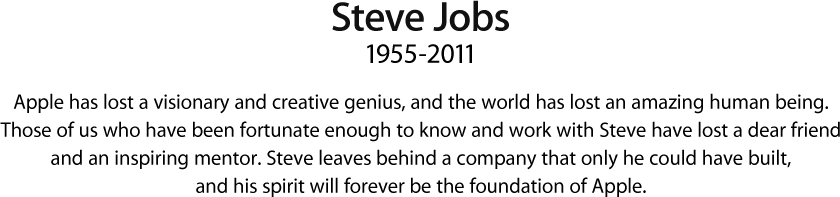
The homepage of Apple's website now displays a full-page image of Jobs with the text: "Steve Jobs 1955-2011."


to end, my favourite commercial (1997)

In many ways, it’s perfect that the video below surfaced again just after Jobs’ passing. It’s the original Apple “Think Different” commercial. In it, images of transformative people throughout the 20th century are shown as a narrator toasts to them for changing the world. In the versions that aired on TV, the narrator is Richard Dreyfuss. But in the version below, the narrator is Steve Jobs.
The toast reads as follows:
Here’s to the crazy ones. The misfits. The rebels. The troublemakers. The round pegs in the square holes. The ones who see things differently. They’re not fond of rules. And they have no respect for the status quo. You can quote them, disagree with them, glorify or vilify them. About the only thing you can’t do is ignore them. Because they change things. They push the human race forward. And while some may see them as the crazy ones, we see genius. Because the people who are crazy enough to think they can change the world, are the ones who do.
Perhaps he didn’t know it in 1997 when he recorded this, but that is absolutely Steve Jobs describing himself. He was crazy enough to think he could change the world. And he did.

[image: Jonathan Mak]