Search This Blog

Showing posts with label NSA. Show all posts

Tuesday, February 25, 2020

Lend me your ears, the Snowden of the world:

Friends, Romans, countrymen, lend me your ears 
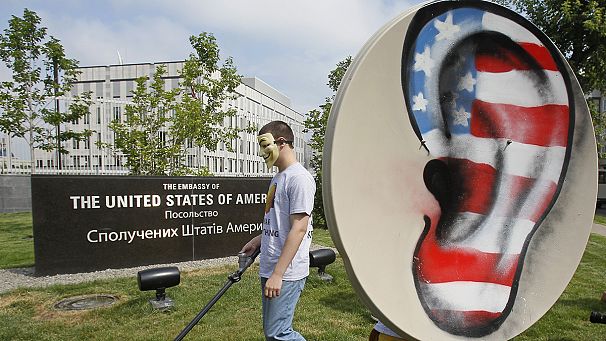
This is the first line of a famous and often-quoted speech

 by Mark Antony in the play Julius Caesar, by William Shakespeare.

What do the CIA, FBI and NSA all have in common? 
Well, they all use TLAs — three-letter acronyms — to refer to themselves.

or in other words, ... 
'us' against 'them':
  • the FBI was created in 1908, and before that
  • the CIA was established in 1947
  • The NSA was unofficially redisgned in  1952
the National Security Agency's existence wasn't even officially disclosed until the 1970s. Until then, Washington insiders joked that the initials stood for "No Such Agency."
Unfortunately for such a secretive agency, the NSA made big headlines this month after a leaker revealed that it collected records of domestic telephone calls between millions of Americans who'd never been accused of any wrongdoing. 


US interest in SPAIN.

Breaking telegraphic codes was quite succesful.
At its best, the confessions of Herbert O Bradley at his office in the Balck Chamber. The office was a branch of the Military Intelligence 
Division, War Department.

All employees were relegated to civilian status. The mission :
"We were to read the secret code and cipher diplomatic telegrams of for-
eign governments — by such means as we could. If we were caught, it
would be just too bad !" 
 According to Yardley's own reminiscences : (1976)

We solved over forty-five thousand cryptograms from 1917 to 1929, and at one time or another we broke the codes of Argentine, Brazil, Chile, China, Costa Rica, Cuba, England, France, Germany, Japan, Liberia, Mexico, Nicaragua, Panama, Peru, Russia, San Salvador, Santo Domingo, Soviet Union and Spain. We also made preliminary analyses of the codes of many other governments. This we did because Ave never knew at what moment a crisis would arise which would require quick solution of a particular government's diplomatic telegrams.


Recent whistleblowers:
June  2012:  
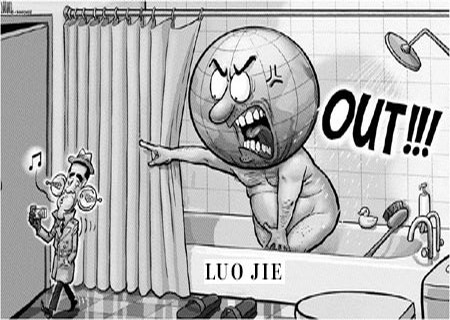
Julian Assange, head of the Wikileaks website, was offered refuge in the London embassy of Ecuador. 
June 2013: 
Edward Snowden sought the relative safety of Hong Kong in the wake of his revelations of the National Security Agency's (NSA) snooping operations in collaboration with internet giants like Google. 
Meanwhile Private Manning is on trial for passing confidential US State Department cables to Wikileaks.


Dissidence. It used to be that the United States stood as the safe haven of the persecuted, open to those yearning to breathe free, and London the place of refuge of all kinds of people who needed a place to be - from disgraced dictators like Metternich to revolutionary exiles like Karl Marx. 


Lack in privacy. Encrypted messages, fancy technology, spies use them all to communicate, but sometimes the best way to hide is in plain sight. Right now, broadcasting across the airwaves around the world, are automated, anonymous shortwave AM radio stations that most governments won't acknowledge even exist, much less explain.

Who said this?


 "Even if you're not doing anything wrong,
   you're being watched and recorded".
Misquoting Picasso:
“The Art of SPYING  is the lie that enables us to realize the truth.”

The following are TWELVE from the 27 quotes from Edward Snowden about U.S. government spying that should send a chill up your spine...
#1 "The majority of people in developed countries spend at least some time interacting with the Internet, and Governments are abusing that necessity in secret to extend their powers beyond what is necessary and appropriate."
#2 "...I believe that at this point in history, the greatest danger to our freedom and way of life comes from the reasonable fear of omniscient State powers kept in check by nothing more than policy documents."
#3 "The government has granted itself power it is not entitled to. There is no public oversight. The result is people like myself have the latitude to go further than they are allowed to."

#5 "The NSA has built an infrastructure that allows it to intercept almost everything."
#7 "Any analyst at any time can target anyone. Any selector, anywhere... I, sitting at my desk, certainly had the authorities to wiretap anyone, from you or your accountant, to a federal judge, to even the President..."

#12 "Allowing the U.S. government to intimidate its people with threats of retaliation for revealing wrongdoing is contrary to the public interest."
#15 "I don't want to live in a world where there's no privacy, and therefore no room for intellectual exploration and creativity."
#16 "I have no intention of hiding who I am because I know I have done nothing wrong."
#17 "I had been looking for leaders, but I realized that leadership is about being the first to act."
#18 "There are more important things than money. If I were motivated by money, I could have sold these documents to any number of countries and gotten very rich."

#21 "You can't come up against the world's most powerful intelligence agencies and not accept the risk."
#22 "I know the media likes to personalize political debates, and I know the government will demonize me."

#24 "I understand that I will be made to suffer for my actions, and that the return of this information to the public marks my end."
#25 "There’s no saving me."
The top-secret PRISM program allows the U.S. intelligence community to gain access from nine Internet companies to a wide range of digital information, including e-mails and stored data, on foreign targets operating outside the United States. The program is court-approved but does not require individual warrants. Instead, it operates under a broader authorization from federal judges who oversee the use of the Foreign Intelligence Surveillance Act (FISA). 


Some documents describing the program were first released by The Washington Post on June 6. The newly released documents below give additional details about how the program operates, including the levels of review and supervisory control at the NSA and FBI. The documents also show how the program interacts with the Internet companies. These slides, annotated by The Post, represent a selection from the overall document, and certain portions are redacted

Sunday, June 16, 2013

Stepping Stones to a surveillance state –by James Bamford

 By James Bamford  -  Mon Jun 10, 2013 8:22pm  http://internacional.elpais.com/internacional/2013/06/15/actualidad/1371327354_762712.html

(Reuters) - "God we trust," goes an old National Security Agency joke. "All others we monitor.
Last week, the Guardian and the Washington Post revealed another massive NSA surveillance program, called Prism, that required the country's major Internet companies to secretly pass along data including email, photos, videos, chat services, file transfers, stored data, log-ins and video conferencing.

Today the NSA is the world's largest spy organization, encompassing tens of thousands of employees and occupying a city-size headquarters complex on Fort Meade in Maryland.

NOVA | The Spy Factory | PBS


There were three Stepping Stones:

STEP ONE (1920-29)
In 1920, its earliest predecessor, known as the Black Chamber, fit into a slim townhouse on Manhattan's East 37th Street.
World War One had recently ended, along with official censorship, and the Radio Communication Act of 1912 was again in effect. This legislation guaranteed the secrecy of electronic communications and meted out harsh penalties for any telegraph company employee who divulged the contents of a message. To the Black Chamber, however, the bill represented a large obstacle to be overcome-illegally, if necessary.
So the Black Chamber chief, Herbert O. Yardley paid a visit to  the headquarters of Western Union. This was the nation's largest telegram company - the email of that day.
Their object was to convince him to grant them secret access to the private communications zapping through his company's wires. It was easier achieved than Yardley had ever imagined.

Time and again over the decades, this pattern has been repeated. The NSA, or a predecessor, secretly entered into agreements with the country's major telecommunications companies and illegally gained access to Americans' private communications.

The influential Republican statesman, Henry L. Stimson, was deeply offended by the very notion of snooping into people's private communications. As the new secretary of state in 1929, Stimson shut down the Black Chamber with the now immortal phrase, "Gentlemen do not read each other's mail."

STEP TWO (1942-75)

But when President Franklin D. Roosevelt later appointed Stimson secretary of war during World War Two, Stimson changed his mind. He wanted to eavesdrop on every possible communication, especially on the Germans and Japanese.

Once the guns of World War Two began falling silent, however, the communications privacy laws again took effect. Thus, Preston Corderman, the chief of the Signals Intelligence Service faced the same dilemma Yardley confronted after World War One: a lack of access to the cables flowing into, out of and through the country.
So, once again, deals were made with the major telegraph companies to grant the SIS secret access to their communications.


Codenamed "Operation Shamrock," agents would arrive at the back door at each telecom headquarters in New York around midnight; pick up all that days telegraph traffic, and bring it to an office masquerading as a television tape processing company. There they would use a machine to duplicate all the computer tapes containing the telegrams, and, hours later, return the original tapes to the company.
The secret agreement lasted for 30 years. It only ended in 1975, when the nation was shocked by a series of stunning intelligence revelations uncovered by a congressional investigation led by Senator Frank Church.
The illegality and vast breadth of this one operation stunned both the left and the right, Republicans as well as Democrats. The parties came together to create a new law to make sure nothing like it could ever happen again.

But that all changed soon after Sept. 11, 2001, when the Bush administration began its warrantless wiretapping program.

STEP THREE (2001-13)

Once again, an NSA director sought the secret cooperation of the nation's telecom industry to gain access to its communications channels and links. Again, the companies agreed - despite violating the laws and the privacy of their tens of millions of customers. Eventually, when the operation was discovered, a number of groups brought suit against the companies, Congress passed legislation granting them immunity.

The NSA was so flooded with billions of dollars from post-Sept. 11, 2001 budget increases that it went on a building spree and also expanded its eavesdropping capabilities enormously. Secret rooms were built in giant telecom facilities, such as AT&T's 10-story "switch" in San Francisco. There, mirror copies of incoming data and telephone cables are routed into rooms filled with special hardware and software to filter out email and phone calls for transmission to NSA for analysis.

Thus, for roughly 100 years, whenever the government knocked on the telecommunications industry's door and asked them to break the law and turn over millions upon millions of private communications, the telecoms complied.

EPILOGUE:
Why not, since they knew that nothing would ever happen to them if they broke the law.
Now, it appears that the NSA has again gone to Verizon and other telephone companies and obtained secret access to billions of private communications. But unlike with Yardley and the Black Chamber, the dangers today of secret cooperation between the telecom and Internet industry and the NSA are incomparable: access to someone's telephone records and Internet activity can provide an incredibly intimate window on their life.
Secret agreements between intelligence agencies and communications companies should not be allowed in a democracy. There is too much at risk.

In a dusty corner of Utah, NSA is now completing construction of a mammoth new building, a one-million-square foot data warehouse for storing the billions of communications it is intercepting. If the century-old custom of secret back-room deals between NSA and the telecoms is permitted to continue, all of us may digitally end up there.
Contrary to what Simpson may have asserted, gentlemen (and women) do read each other's mail - at least if they work for the National Security Agency.
And in the future, given NSA's unrestrained push into advanced technologies, the agency may also be able to read your thoughts as well as your mail.

(James Bamford writes frequently on intelligence and produces documentaries for PBS. His latest book is "The Shadow Factory: The Ultra-Secret NSA from 9/11 to the Eavesdropping on America.")
(James Bamford)