 Money is time, time is money, the proverb goes. But ...
Most people don't spend much time wondering what money is, their major concern is how much they have, and how to get more. In economics (properly understood), the answer to the question - what is money? - consists of three words: Money is a "medium of exchange". That's all. Yet the conception of a "medium of exchange" ranks below only language (with its corollaries - speech and the written word) as the greatest intellectual discovery in history. Without language, the exchange of anything but the most rudimentary ideas is impossible. Without money, the production and exchange of anything is not difficult, or time consuming, or inefficient, it is IMPOSSIBLE!
Here we have three quotes on money:
A wise man should have money in his head, but not in his heart.
Jonathan Swift All I ask is the chance to prove that money can't make me happy.Spike Milligan A man has one hundred dollars and you leave him with two dollars, that's subtraction.
Mae West
What Is Money?
Some of these news are fake, some true... But can you spot the forged ones? (key below)
NEWS1. “A Manhattan woman has sued a $19,000-a-year preschool her daughter attended, arguing that the program failed to adequately prepare her daughter for the test required to enter New York City’s hypercompetitive private school system.
The suit, filed by Nicole Imprescia on Friday in State Supreme Court in Manhattan, said the York Avenue Preschool had not fulfilled its stated commitment to prepare her 4-year-old daughter, Lucia, for the intelligence test known as the E.R.B. “The school proved to be not a school at all, but just one big playroom,” the suit claimed. (to be read in the globalsociology blog.)

As the pound meanders towards parity with the euro, should we abandon the good ship sterling? There’s been a renewed call for hooking up with our continental neighbours’ currency in recent months, and the issue has hit the headlines again after one oposition leader pointed out current financial policy was doing the pound no favours.
It seems crazy to have a pop at a person who wants to be the next man in charge of the economy, because he pointed out what is glaringly obvious – the pound is a bit rubbish at the moment. In some ways this is good. It should help our businesses to export more, but for many it's something to be cheesed off about.


NEWS3. The currency sign for the popular quid is £, which is usually written with a single cross-bar, as on sterling bank notes, though a double cross-bar (₤) is also sometimes seen. The pound sign derives from Librae in Roman £sd units (librae, solidi, denarii) used for the three items. Finally the British currency system got decimal. Believe it or not 1965 The Board of Trade and the Confederation of British Industry declared their full support for metrication and decimalisation. The Metrication Board was set up in 1969 and currency decimalisation took place on Decimal Day, 15 February 1971. Norman Davies shows that opposition to metrication aroused passionate feelings in a number of
disparate quarters. One group, BWMA, believed that compulsory metrication constituted an
attack on British culture and a breach on civil rights.
DOLLAR = buck

 NEWS4. At the start of the year, one buck would get you 1.17 Canadian dollars, which was a pleasant surprise to American tourists, including the man who exclaimed, "I had no idea those people up north had their own money."
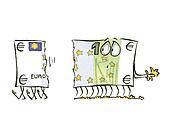
Our more ecological money, the 100-euro note, to illustrate our piece of news on the euro:
NEWS5. Fighting fire with fire:

 IT WAS the Great Fire of 1666 that prompted the establishment of London’s modern fire brigade, organised at first by private insurers, but later coming under public management. In Paris, on the initiative of Louis XV, the pompiers have been fighting fires since 1733. Few Europeans today could imagine a city without a public firefighting service, or a home without fire insurance. But when the architects of the single currency built the euro, they thought that sharing the risk of disaster might merely encourage recklessness and even arson. Better than this moral hazard was to make each country master of its own fate. Why should those living in brick houses save the feckless in their wooden huts?
NEWS6. Canada Boldly Goes With New Five Dollar Coin THE ROYAL CANADIAN MINT– Canada is ready to phase-in the country’s first five-dollar circulation coin. Gaining approval and royal ascent for the proclamation authorizing the issue and prescribing the composition, dimensions, and design of the new coin has been a long trek, but with Canada’s continuing mission to reduce the amount of paper money in circulation, a five-dollar coin was the next step. To coin a phrase, “It was only logical.”
For some humour related issues :
For the pronunciation of the euro (great diversity indeed, see wikipedia here)
Mind you, the bestest joke, the symbol of Dollar is ..... correct which spelling does not include any "S"!!!!!
KEY: these news are fake, news 4 & 6.
some are true: news 1, 2, 3 & 5.

