Search This Blog

Showing posts with label history of chess. Show all posts

Wednesday, April 3, 2019

names: Shah, regina, rook, 8 comyn people; schachorum ludo -ajedrez -chess


The name of the items of the game got adapted to the new lands were it was played: 
  • Persia, Islamic kingdoms, Hebrew medieval wise people and Christian Europeans.
  • alterumque nomen mediaevale quod habetur esse quasi terminus technicus ludi. In enumeratione quae sequitur, nomen purius litteris fortibus scribitur; nomen technicum, litteris fortibus et italicis. Cuique lusori sunt:
  • rex, sive scaccus
  • regina (vel virgo, vel amazon, vel domina), sive dama (unde damicus ludus), vel fercia
  • turres, vel elephantes, sive rochi
  • episcopi (vel satellites, vel signiferi, vel cursores, vel sagittiferi), sive alfīni
  • pedites, vel pedini, sive pedones

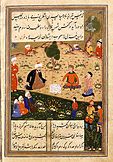
Rumi's poem dedicated to Shams (circa 1500=)
The Persians took from the Indians the essentials of the game -- the six different figures, the board with sixty-four squares -- and rebaptized the pieces with Persian names. This new nomenclature was to have enduring significance far beyond the East, for shah, the Persian word for "king," ultimately served as the name of the game in several European languages by way of the Latin scacchus: scacchi in Italian, Schach in German, échecs in French, and chess in English, among others.
Even in this “known” history, Yalom can deliver a surprise:
The Persian term shah mat, used in this episode, eventually came down to us as “check mate,” which literally means “the king was dumbfounded” or “exhausted,” though it is often translated as “the king died.”
some of the chess pieces took on Arabic names (al-fil for elephant, baidak for pawn, and firzan, fri or ferz for the general or vizier) while others retained their Persian labels (shah for king, rukh for rook, asp for horse).

In Europe some of the pieces gradually got new names:
  • Fers: "queen", because it starts beside the King.
  • Aufin: "bishop", because its two points looked like a bishop's mitre; In French fou; and others. Its Latin name alfinus was reinterpreted many ways

Retrieved from the excellent Carol Hamill's webpage :
Recreating Medieval Chess:  from schachorum ludo to the queen’s chess

The game spread throughout Europe in the 9th century. The earliest written European accounts are written in Latin, making reference to schachis (chessmen) with various spellings or to schachorum ludo (the game of chessmen). One word of caution, the Romans did not play chess. Their game of ludus latrunculorum is not related to chess and the Latin term schachi can refer to various game pieces including those for draughts and backgammon. 
The modern game (called the new chess or the queen’s chess) belongs to the period after 1500 CE.

E = Einsiedelnpoem    CB = Carmina Burana

Table # 2   Comparitive nomenclature within Europe


Medieval Latin

scacchi
scaccarium

various spellings
French


eschès
echecs
Middle English


cheschess
German


schach
Italian


scacchi
scacco


rex
roy
kynge
könig

re


ferzia
femina, regina conjunx CB
then: regina (E)
fierge fierce
dame(1500)
fers   (Chaucer)
quene(Caxton)
dame
regina


alfinus, alphinus
alphicus (leper)
alfiere( standard-bearer)
aificus (‘horned head’) CB
comes, curvus(count or aged one) (E)
Vida’s poem (1547) use of terms for archer
alfin, aufyn(OF)
fou (fool)
alphyn(Caxton)
wise man sitting in chair holding a bo
läufer (runner)
standard-bearer


eques 
(E) and CB
caballarius

chevalier
(knight)
knyght

springer
(leaper)
cavallo


cus
rochus
Vida’s poem (1547) use of terms for elephant with tower
roc
rook (Caxton)
legat 
of the kynge -  
man on horseback
roch
rocco

pedes
(foot soldier)
pion(pawn)
comyn people(Caxton) in 8 categories
bauer


names in Germany: 
Einsiedeln Poem:  Versus de scachis (Verses in Chess) Latin,  written by a German monk in Switzerland, circa 997 CE.     king= rex; queen= regina; bishop= comes count or traveller or  curvus aged one or crooked; knight eques; rook= rochus; pawn= pedes       
Carmina Burana Latin. poem of rhymed couplets circa. 1210The poem indicated that the queen is placed to the right of the king.rex; 3 names here: femina  - name of original piece - &  regina    - name of ‘queened pawn’ & conjunx (Note: the author avoids the problem of a king having two queens(); alficus "horned head"; eques; rochus & pedes.  

 Medieval Chess as played in France and England - a reconstructionThe chequered board would have been likely black and yellow or black and white.The terms used would be in French:     roi (king);  fierce (advisor);  alfin or fou (elephant or fool);  chevalier (knight);  roc (rook) & pion (pawn).      
 

The evolution of the rook – from chariot to castle

The rook was the most powerful piece on the medieval chessboard. The term ‘rukh’ sounds like roka (boat ) used in the Ganges valley and like rukhkh the Arabic term for "the horseman who is commander of the army" In Persian rukh means war chariot. The abstract curved flat piece used by Arab chess players would have left plenty of room for Europeans to decide for themselves, what the rook represents.The European rook took many forms. In the Charlemage chessmen set, (circa 1080) the rook is carved as a chariot with driver and horses. The Lewis chessmen of the mid 1100’s have rooks that resemble soldiers each has a helmet, shield and sword. Alfonso X’s The Book of Games (1283) describes the rook as "made wide and stretched because they resemble the ranks of soldiers". Cessolis (circa 1300) calls them "vicars or envoy’s of the king" (Yalom, p.70). In the Latin poem, Scacchia Ludusof 1537, by Vida, the rooks are described as "warring towers borne upon the backs of elephants" (Parlett p.304) By the mid 16th century the rook is represented by the tower alone, (Hammond p. 107).

A French translation of De ludo scachorum by Jacques de Cessoles (various spellings) was done by Jehan de Vignay in 1380. This French translation was used as the basis of Caxton’s very important English translation discussed later. In French the game was called: eschès, and later échecs.The Latin term scacchi and the term échecs could also be applied to game pieces in general such as in draughts, tables or merels. (Parlett p.300). Caution such be used when reading period documents. Many references that appear to discuss chess could be related to some other game, (this is especially important with reference to Scandinavian sources).The pieces: roy, roi (king); fierce or fierge (advisor), later dame (queen); alfin, aufyn or fol , in modern French fou (fool ); chevalier (knight); roc by 17th c. this became tour (castle) & pion (pawn)
Caxton’s Game and Playe of the Chess: a moral treatise on the duties of life. - first published 1474The bulk of this work is a translation of the French translation (Jehan de Vignay 1380) of the Latin workDe ludo scachorum by Jacques de Cessoles (various spellings) written in Italy. This is the second non-religious book to be printed in the English language (Golombek p. 63) and it was very popular. At one time two hundred codices could be found in the various public libraries of Europe. It includes a description of how each piece ought to appear an how that class of people ought to behave. 
The terms, and descriptions used include:kynge, sitting on chair, clothed in purple "betokens virgyns and damesels"quene, (moves on own colour) sitting on chair clothed in gold with furalphyn (limited elephant-type moves) "betokenyth wise men" (Caxton) sitting on chairnote: that this is note the same as the standard bearer (Cesssolis) or the fol (de Vignay)knyght, gentlemen, sitting on horserook "vicaires and legats of the king" sitting on a horse same description as used in the original by Cessoliscomyn people each pawn is associated with a category of trades people 
1 labourers and workmen 2 smyths 3 notaries, advocates drapers cloth makers 4. merchants money changers 5 physicians apothacaries, 6 tavern keepers 7 guards and "keepers of the city" 8 "ribaulder, disepleyar and currours" - loosely translated as "irregular retainers, and displayers and cursers.
Note that the modern bishop piece called alphyn is described as representing a wise man and the rook represents a legit of the king.

Saturday, October 22, 2011

the birth of the queen of chess

Birth of the Chess Queen: A History - by Marilyn Yalom - HarperCollins, 2004
Reviewed by Rick Kennedy

I can summarize Yalom’s Birth of the Chess Queen: 
a) the game of chess we play today has evolved from an earlier game with different rules and pieces; 
b) over time, the eleventh through fifteenth centuries, the Vizier, or advisor to the King, was replaced in Europe by the Queen, which then further morphed from the weakest piece on the board to the strongest one; and c) the transformation of the chess Queen paralleled the rise of various powerful real-life queens.
For many readers, the first part of the tale will be familiar.
Though historians still debate the exact origins of chess, most agree that it emerged in India no later than the sixth century.  In Sanskrit, the game was called chaturanga, meaning “four members,” which referred to the four parts of the Indian army: chariots, elephants, cavalry and infantry.  This fourfold division, plus the king and his general, provided the basic pieces of the game, first in India and then throughout the world.
As people and armies moved in conquest across lands, the game of chess followed.  As people adapted and adopted the ways of new cultures, so did chess.
The Persians took from the Indians the essentials of the game – the six different figures, the board with sixty-four squares – and rebaptized the pieces with Persian names.  This new nomenclature was to have enduring significance far beyond the East, for shah, the Persian word for “king,” ultimately served as the name of the game in several European languages, via Latin.
As the Muslims expanded their empire, in the seventh through eleventh centuries, again, chess traveled with them.
Arabic became the dominant language in many of these conquered lands, and some of the chess pieces took on Arabic names (al-fil for elephant, baidak for pawn, and firzan, fri or ferz for the general or vizier) while others retained their Persian labels (shah for king, rukh for rook, asp for horse).
The stage is set for the entrance of Her Majesty:
We have seen how the chess queen appeared around the year 1000 as a European replacement for the Arabic vizier, taking over his slow, one-step-at-a-time diagonal gait.  Despite slight regional differences, this is the pace she maintained throughout the Middle Ages.
Almost as dramatic as the modern-day pawn being promoted, upon reaching the 8th rank, and changing into a modern-day queen, (although not as instantaneously), over the years the old style queen grew in power and mobility.  Why?  Here we have the crux of Yalom’s thesis:
Yet, from the twelfth century onward, she seems to have acquired special value, far beyond her limited mobility on the board…The heightened authority invested in queenship during the course of the Middle Ages spilled over to the little queen on the board and paved the way for her to become the game’s mightiest piece...It should not surprise us that the queen’s official transformation into the strongest piece on the board coincided with the reign of Isabella of Castile (1451-1504).
From the quotes I have presented, you can see that Birth of the Chess Queen is an accessible work, not the stereotyped dusty and impenetrable “academic” tome.  This style stands Yalom in good stead, and can make her book enjoyable reading for those interested in her slice of early chess days.  At times, though, especially when telling the tales of royalty, the author takes on almost a breathless quality in her writing (one unsympathetic reviewer compared it to People magazine).  One example, of many:
In 1137, the young, elegant princess married Louis VII, when they were fifteen and sixteen years old, respectively.  She left the sunny court of Aquitaine for the murky skies of Paris.  There her lively mind, nourished on lyrical poetry, came in contact with the more earnest theological debates favored by her monkish husband.  There is no doubt that Louis, deeply in love with his stunning young wife, was initially more influenced by her than she by him.  She did her best to recreate in Paris the brilliant court life that had flourished in Aquitaine, replete with troubadours, storytellers, jugglers, and entertainment of every sort, including games of chance and chess…
Also, because history does not record much – and, much less so, of the lives of women – Yalom is left presenting some of the stories she finds, however shaky, as if to get them on the record, lest they be lost again.
Mathilda’s marriage to Ezzo, the count of Palatine, is associated with a chess anecdote that is too good to be left in silence, even if its veracity is questionable.  As the story goes, Mathilda was married to Ezzo, the count Palatine, after her youthful brother, Otto III, acting as her guardian, lost her to the elderly count over a chess match.  It is impossible to determine whether this tale is true, but Otto III is known to have been a quixotic personality, so the decision to marry off his sister in this fashion is not entirely out of keeping with his character.  We do not know the date of the event or even the age of the bride…


second review at The Guardian (2004):

Chequered past of the first lady

Steven Poole surveys the emergence of a new game


Yalom enjoys telling the stories of her favourite queens: Matilda of Tuscany, Eleanor of Aquitaine, Blanche of Castile, Margaret of Denmark and particularly Isabella of Castile, who ruled Spain along with her husband Ferdinand at the time of the chess piece's ascension to superpower status.
These queens, on Yalom's admiring accounts, could do little wrong: they are celebrated for courage and fortitude, and even occasionally fighting in battle themselves. Yalom acknowledges hastily that yes, Isabella drove Jews and Moors from her shores and instituted the Spanish Inquisition, but this just makes Isabella's a "mixed legacy". Well, some legacies are more mixed than others. In a curious little historical irony, chess, among the pursuits banned by the Taliban, was one of the enduring gifts to Europe of the Arabs, whose expulsion by Isabella still rankles among Islamist terrorists today.
Doubtless there is some truth to the idea that examples such as Isabella made the appearance of a kick-ass female monarch on the chessboard more credible. Yalom points out that in Russia, the old vizier did not become the queen or "tsaritsa" until much later, when the historical example of Catherine the Great was available. On the other hand, Yalom's thesis cannot be generalised too much. It is not as though the world had never known powerful female rulers before the early-modern period. And bishops and kings are still as powerful in today's chess as they were five centuries ago, despite their waning influence in the western world.
Meanwhile, Yalom's coyly touted "discovery" of a "hidden relationship" between chess development and the cult of the Virgin Mary is much less persuasive. Where there does not exist a documented link between one of her spunky heroines and chess, moreover, Yalom feels happily inclined to invent it. Thus the pages are littered with phrases of wishful thinking: "On their actual journey to Byzantium, Eleanor and her caravan of noble ladies most probably brought chess sets with them..."; "In all probability, [Adelaide] promoted the game of chess."
Exuberantly, Yalom strays beyond her thesis as narrowly defined, with a chapter on courtly love and the imagery of chess as a metaphor for sex in numerous engravings showing young couples playing, and also examines the rich material for instruction and warning that chess provided to moralists - who, for example, were deeply worried about the implied polygamy of the fact that one side could eventually attain several queens. She writes in a style that combines briskness with a somewhat cloying smell of baking cookies: Eleanor, for example, wore her various royal titles "as easily as the rich textures that adorned her body". And when Yalom laments the fact that a tome entitled The Edifying Book of Erotic Chess "was tragically destroyed" in the firebombing of Dresden, one might reasonably propose that its loss was not among the most tragic results of that catastrophe.