Search This Blog

Showing posts with label China. Show all posts

Sunday, May 10, 2020

Fredoom of expression. WE want to break .... freaky-US 2030

1.  The superleague

China and Friends vs   USA and allies


2010 60-second advert  was banned publicly 


This Group produce it. It was not acceptable to be wached. 
video -link  

1.1.  The content  scripted
Perhaps it is what the Chinese Professor says at the end that is alarming the big television networks. Judge yourself.

  • Why do great nations fall? The Ancient Greeks, the Roman empire,
  •  The British empire, The US of America.
  • They all make the same mistakes.  
  • Turning their backs on the principles that made them great.
  •  America tried to spend and tax itself out of a great recession.  
  • Enormous so-called "stimulus" spending, massive changes to health care, 
  • government takeover of private industries, and crushing debt." 
  • "Of course, we owned most of their debt, so now they work for us".
1.2.  The controversial object - video

_______future plusquamperfect US -2030___________


CONTEXT:

U.S. National Debt Through the ages -link

  • the U.S. debt-to-GDP ratio has remained above 100 percent since 2013. 
  • During fiscal year 2017, the total national debt passed $20 trillion for the first time in the nation’s history. Debt levels continue to rise.

1.3.  These  seven  Comments Posted on YouTube


  • “I want everyone in my contacts folder to see this video.  I just saw it on Neil Cavuto and it scared the living day lights out of me.   It was the most terrifying thing I’ve ever seen.” 
  • “One of the most powerful ads I’ve seen during my life time. Thank you for getting the word out.” 
  • “The best…ad for the American people yet!  *****, 5 stars for forcing our politicians face the truth.”
  • “One of the most powerful ads I’ve seen during my life time. Thank you for getting the word out.”
  • “One of the most potent ads I’ve ever seen.”
  • “Brilliant. A vision of the future.”
  • “Awesome. Definitely ONE possible future, unless we act now.”
  • “Thank you for producing this ad. EVERYONE needs to see it and realize what our future might very well be. This is not about China… it is about what we are allowing to happen to this great nation!”


Fredoom of expression.
 WE want to break freaky


4. Old piece 

Thomas Friedman: WikiChina -NYT,  Dec 2, 2010


Washington Embassy, People’s Republic of China, to Ministry of Foreign Affairs Beijing, 
TOP SECRET/Subject: America today.
Things are going well here for China. America remains a deeply politically polarized country, which is certainly helpful for our goal of overtaking the U.S. as the world’s most powerful economy and nation. But we’re particularly optimistic because the Americans are polarized over all the wrong things.
  • 1-There is a willful self-destructiveness in the air here as if America has all the time and money in the world for petty politics. They fight over things like — we are not making this up — how and where an airport security officer can touch them. They are fighting — we are happy to report — over the latest nuclear arms reduction treaty with Russia. 
  • Americans just had what they call an “election.” Best we could tell it involved one congressman trying to raise more money than the other (all from businesses they are supposed to be regulating) so he could tell bigger lies on TV more often about the other guy before the other guy could do it to him. This leaves us relieved. It means America will do nothing serious to fix its structural problems: a ballooning deficit, declining educational performance, crumbling infrastructure and diminished immigration of new talent. 
  • 2- The ambassador recently took what the Americans call a fast train — the Acela — from Washington to New York City. Our bullet train from Beijing to Tianjin would have made the trip in 90 minutes. His took three hours — and it was on time! Along the way the ambassador used his cell phone to call his embassy office, and in one hour he experienced 12 dropped calls — again, we are not making this up. 
  • We have a joke in the embassy: “When someone calls you from China today it sounds like they are next door. And when someone calls you from next door in America, it sounds like they are calling from China!” Those of us who worked in China’s embassy in Zambia often note that Africa’s cell phone service was better than America’s. 
  • In foreign policy, we see no chance of Obama extricating U.S. forces from Afghanistan. He knows the Republicans will call him a wimp if he does, so America will keep hemorrhaging $190 million a day there. 
  • 3- Most of the Republicans just elected to Congress do not believe what their scientists tell them about man-made climate change. America’s politicians are mostly lawyers — not engineers or scientists like ours — so they’ll just say crazy things about science and nobody calls them on it. It’s good. It means they will not support any bill to spur clean energy innovation, which is central to our next five-year plan. 
  • And this ensures that our efforts to dominate the wind, solar, nuclear and electric car industries will not be challenged by America. 
  • Finally, record numbers of U.S. high school students are now studying Chinese, which should guarantee us a steady supply of cheap labor that speaks our language here, as we use our $2.3 trillion in reserves to quietly buy up U.S. factories. 
In sum, things are going well for China in America.

______________US -2030_____________


3 lines: 
1-For its maker
3- Reactions in youtube

1-For its maker: CAGW. A new television ad about the U.S. national debt produced by Citizens Against Government Waste has been deemed "too controversial" by major networks including ABC, A&E and The History Channel and will not be shown on those channels. The commercial is a homage to a 1986 ad that was entitled "The Deficit Trials" that was also banned by the major networks. Apparently telling the truth about the national debt is a little too "hot" for the major networks to handle. But perhaps it is time to tell the American people the truth. In 1986, the U.S. national debt was around 2 trillion dollars. Today, it is rapidly approaching 14 trillion dollars. The American Dream is being ripped apart right in front of our eyes, but apparently some of the major networks don't want the American people to really understand what is going on.

The truth is that the ad does not even have anything in it that should be offensive. The commercial is set in the year 2030, and the main character is a Chinese professor that is seen lecturing his students on the fall of great empires. As images of the United States are shown on a screen behind him, the Chinese professor tells his students the following about the behavior of great empires: "They all make the same mistakes. Turning their backs on the principles that made them great. America tried to spend and tax itself out of a great recession. Enormous so-called "stimulus" spending, massive changes to health care, government takeover of private industries, and crushing debt."

Perhaps it is what the Chinese Professor says next that is alarming the big television networks: "Of course, we owned most of their debt, so now they work for us".

2- Analysis on truth-out


The Chinese government was able to get its banks to open their lending windows when US banks were being tight-fisted with their funds, because the government owns the banks. The Chinese banking system has been partially privatized, but the government is still the controlling shareholder of the Big Four commercial banks, which were split off from the People's Bank of China in the 1980s.
We might take a lesson from the Chinese and put our own banks to work for the people, rather than making the people work for the banks. We need to get our dollars out of Wall Street and back on Main Street and we can do that only by breaking up Wall Street's out-of-control private banking monopoly and returning control over money and credit to the people themselves.


Thursday, May 2, 2019

Get to grips with Chinese-English for Lovers

A Concise Chinese-English Dictionary for Lovers 
by Xiaolu Guo - The Guardian - review
Chatto & Windus £12.99, pp368
I not Chinese. I British. I prefer read book with sentences not made look like broke. I prefer writer who not pretend not speak English when actually I think she speak English very goodly.
If you think this is annoying in a review, you might want to think carefully before picking up A Concise Chinese-English Dictionary for Lovers. 
 
Heathrow airport is Heathlow airport. Fizzy water is filthy water. A rucksack is a rocksack. There are lots of points that Xiaolu Guo is trying to make with her use of language: about Chinese and British culture, about the impossibility of perfect communication between two people, about belonging and not belonging. But the cod-pidgin is not so much grittily authentic as a stagy literary device that never really convinces, and it's no coincidence that as Z's English improves so does the novel.
Xiaolu's book is original, humorous, and wise. Within imperfect language one can find many perfect truths of the human condition. The misunderstandings are really the understandings of the differences of the heart between men and women.       
                    Amy Tan, author of The Joy Luck Club

   But I at neither time zone. I on airplane. 
I not met you yet. You in future.
I worry bending passport bring trouble to immigration officer, he might doubting passport is fake and refusing me into the UK, even with noble word on the page: Below is ocean. I from desert town. Is the first time my life I see sea. It look like a dream.As I far away from China, I asking me why I coming to West. Why I must to study English like parents wish? Why I must to get diploma from West? I not knowing what I needing. Sometimes I not even caring what I needing. I not caring if I speaking English or not. Mother only speaking in village dialect and even not speaking official Mandarin, but she becoming rich with my father, from making shoes in our little town. Life OK. Why they want changing my life?And how I living in strange country West alone? I never been to West. I not having life in West. I not having home in West. I scared.I no speaking English.I fearing future.
                      (excerpt)                      

A ravishing reviewer -Linda B. at Amazon:Zhuang gives up her name because English people cannot pronounce it, calling herself Z, and boards with a Chinese family.As Z becomes more proficient in her new language the book offers insight into her cultural point of view. Finding her lover selfish, Z observes that the Chinese are not encouraged to use the word "self" since it is the antithesis of collectivism and the self is the enemy of the communist party. On a holiday to Wales the profound silence saps her: "It doesn't matter if one speaks Chinese or English here; it doesn't matter if one is mute or deaf. Language is not important anymore. 


Another three comments:reader_A) the book starts in pretty dreadful English and every chapter has a specific heading such as in a dictionary. There are very funny scenes in the book for example when Z arrives in London: "Sign in front of queue say: ALIEN and NON ALIEN. I am alien, like Hollywood films Alien, I live in another planet, with funny looking and strange language." 
reader_B) When I first started to read this I was put off by the way it has been deliberately written in bad English. However once I got to grips with this and realised it was really a necessary and integral part of the novel I began to enjoy it much more, finding it both witty and charming. 

reader_C) The book is definitely not worth the new purchase price (I didn't buy it new anyway). I won't be coming back to this for successive reads of this text. $1 plus shipping is what I spent, and that's about what it is worth
For future readers, my fav Chapter (14). Click below 

A Concise Chinese English Dictionary for Lovers 


       Xiaolu Guo, Granta Best Young British Novelists 2013


Xiaolu Guo, a bilingual novelist and filmmaker, received her MA at Beijing Film Academy and UK's National Film & TV School. She published 6 books in Chinese before moving to London in 2002. Since then she has written her novels in English, notably:
  • A Concise Chinese English Dictionary For Lovers (2007), 
  • 20 Fragments of A Ravenous Youth (2008), 
  • UFO In Her Eyes (2011) 
  • Lovers in the age of indiference (2011)
  • I am China (2014)
Her feature film She, A Chinese () received the Golden Leopard Award at the Locarno Film Festival 2009. Her documentary Once Upon A Time Proletarian (2009) received the Grand Prix Geneva 2012, has shown in Central Pompidou Paris, MoMA New York and toured around the world.

Thursday, November 2, 2017

Business card etiquette - Do not waive at the Cultural aspectes

There are guidelines 

for making a positive and lasting impression 

when giving and receiving business cards.


Unlike in North America  where the business card has little meaning other than a convenient form of capturing essential personal details, in other parts of the world the business card has very different meanings.


General Business Card Etiquette Tips

  • Business cards are an internationally recognised means of presenting personal contact details, so ensure you have a plentiful supply.
  • When travelling abroad for business it is advisable to have one side of your business card translated into the appropriate language.
  • Good business etiquette requires you present the card so the recipient's language is face up.
  • Make a point of studying any business card, commenting on it and clarifying information before putting it away.

The story is about a little wave, bobbing along in the ocean, having a grand old time. He’s enjoying the wind and the fresh air—until he notices the other waves in front of him, crashing against the shore. 

   “‘My God, this is terrible,’ the wave says. ‘Look what’s going to happen to me!’ 
   “Then along comes another wave. It sees the first wave, looking grim, and it says to 
him, ‘Why do you look so sad?’ 
   “The first wave says, ‘You don’t understand! We’re all going to crash! All of us waves 
are going to be nothing! Isn’t it terrible?’ 
Costa Tarjeta De Visita


   “The second wave says, ‘No, you don’t understand. 

You’re not a wave, 
you’re part of the ocean.’” 
               (From M. Albom's Tuesdays with Morrie)


Everybody knows waves mean..... many things. As the saying goes: "You pays y'r money and you takes the chances."


Now Do this test When my country ruled the waves: 

What your Business Card Etiquette says about you! from Mark Jeffries

    1. Business Card Etiquette in ............

  • Have one side of your business card translated into local language printed in gold ink since gold is an auspicious colour. 
  • Your business card should include your title. If your company is the oldest or largest in your country, that fact should be highlighted on your card. 
  • Hold the card in both hands when offering it.
  • Never write on someone's card unless so directed.

    2. Business Card Etiquette in ............

  • If you have a university degree or any honour, put it on your business card. 
  • Always use the right hand to give and receive business cards. 
  • Business cards need not be translated into the native language as English is widely spoken within the business community.

    3. Business Card Etiquette in ............

  • Business cards are exchanged with great ceremony. 
  • Invest in quality cards.
  • Make sure your business card includes your title. The locals place emphasis on status and hierarchy.
  • Business cards are always received with two hands but can be given with only one.

    4. Business Card Etiquette in ............

  • Business card etiquette is relaxed in the country and involves little ceremony.
  • It is not considered bad etiquette to keep cards in a pocket.
  • Business cards should be kept clean and presentable.
  • Do not feel obliged to hand out a business card to everyone you meet as it is not expected.

Answer KEY:
Do not waive the rules,
Do not cheat....
see the end of our post

Linguistic crossroads. Some meanings are best avoided:
  • The name Coca-Cola in China was first rendered as Ke-kou-ke-la. Unfortunately, the Coke company did not discover until after thousands of signs had been printed that the phrase means "bite the wax tadpole" or "female horse stuffed with wax" 
  • In Taiwan, the translation of the Pepsi slogan "Come alive with the Pepsi Generation" came out as "Pepsi will bring your ancestors back from the dead." 
  • Microsoft had to think twice about bringing its Bing search engine here because in Chinese, the most common definitions of the character pronounced “bing” are “disease,” “defect” and “virus” — rather inauspicious for a computer product. 
  • Peugeot (Biao zhi) sounds enough like the Chinese slang for “whore”

======
KEY    When my country ruled the waves: 

1-China    2-India   3- Japan  and 4-UK

Saturday, March 16, 2013

Mei ban fa. Language teaching in rural China a national embarrassment.


Learning English in China? “Mei ban fa.” (It can’t be done.) 

SEEING Red in China, a blog by an American teacher there, makes a provocative argument. Behind the eye-catching number that 300m people either are learning or have learned English in China is a depressing reality. Classes are extremely poor, the teachers themselves not fluent in English. Rote memorisation is the norm—a fact Tom, the blogger, buttresses with his own experience of reading Chinese texts out loud, for hours every day, at Beijing's specialist university for foreign languages.  He says he was never once asked to produce his own sentences. Shocking if true.
By the by, he makes another provocative point: that rural literacy in Chinese (not English) is in fact far worse than authorities say. Farmers simply don't use the written language enough to maintain their knowledge of thousands of characters. 

Yet from the moment you step off the plane, you start to question whether or not 25% of the population really learned anything more than “Hallloow,” “A-What-a is-a your name-a?”. and “I’m fine, thank you and you? (with a rapidly rising pitch to indicate the question mark)” and “Chinglish” signs abound as online translators (like Google translate) seem to be the only authority on language, where  much Chinglish spreads.  
As in the picture.


Summary: deep impression to your 2 points mentioned from the magazine:  poor level of English and poor literacy from farmers. Up to 3oo million English learners??
“The job of a journalist is to simplify and to exaggerate” 
– John Humphrys
About the deat of English, click here.

Some reflexions from English teachers who worked there:
1. NO USE. I taught English there for a few years myself. After school, there’s simply no need for them to use it. I didn’t know much Chinese by the time I left, but I can tell you…not using it at all for the last six years has me remembering little more than “ni hao”. I can’t even remember the names of most food I used to love! So I think the problem is probably largely due to lack of use.
2. TESTS. The main problem facing effective teaching in China is indeed the gaokao, as well as its relatives CET and TEM. These tests do not check real acquisition of language, but just the rote memorization of vocabulary lists and grammar structures. It’s perfectly possible to ace the gaokao and be entirely unable to communicate in English. Since these tests are the only thing that matter, all English teachers (generally) do is cram as much repetition as possible in and cut out anything even vaguely communicative. 
3. LIES: Here is something of a pattern with a lot of things in China: There is a stupid policy, everyone recognizes it’s stupid, but it has to be done, so everyone gets to work to “get it done.” That is, by cheating, by faking, by lying, or by whatever it takes. In the end the leaders on the higher level make a bigger lie out of many smaller lies on the lower levels; but given time, just about everyone begins to believe the house of lies they have built.
4. FROM OUTSIDE. What you are experiencing is shared:  “Am I wasting my time? Are they learning anything? Is it just about the test and getting credit?” “When can I go home?” Very few if any of the local people can communicate even after 6 years of language classes and more if they move on to some kind of post secondary education.
5. FACE OR SHAME. the Chinese don’t actually care what they get out of English lessons. They merely do it for face. It’s their equivalent of Americans over-extending themselves financially to drive a bloody German car that’ll impress their friends. You know very well not to trust a single Chinese statistic. to assume 95% can read and write in Chinese is as fabricated as the goods they sell.
6. FLAWED TEACHERS. When I went to college in Nanyang, Henan, my English teachers were all a joke. I had Greg Rhue the girl touching drunk, Jerry Urbanthe stupid and violent, and Robert Baggio the sociopath pedophile. They all “taught” this old ESL grammar/game/scenario English class. It was nothing more than a waste of time. The teachers were all losers from their own country who had some sort of professional god complex because they speak English. I hated it actually. 
7. TECHNOLOGY. We need a new method that will be based on latest developments in our Digital era and new learning habits of Digital Learners.  It is nearly impossible to think in Chinese and try to speak in English; learners should be given a tool that will automatically stop cross-translation and help them to formulate direct links between English words and images and situations which they describe without using subconscious translation into Chinese. Also, we need to  trains the brain to recognize sounds (phonemes) and word blocks in a new language. See Arkady Zilberman's Language bridge
MEI-BAN-FA GOES GLOBAL: 
  • Believe it or not, this actually sounds like the situation in Hong Kong too!
  • Errrr, try living and teaching in Italy. You don’t have to go that far to encounter all of the aforementioned problems!!!!!!!!
  • The truth is the majority of island native Puerto Ricans speak next to no English. The official stat is 17% fluency in English

Monday, November 19, 2012

Hans Rosling and data visualization


Hans Rosling: The Jedi Master of data visualization 


Dr. Hans Rosling is one of my presentation heroes; he's been featured or mentioned in all my books and several times on presentationzen.com over the years. If there is a Jedi Master of presenting data clearly, visually, and simply, then it is Hans. He proves time and time again, that data are not dull—and when you are trying to change the world, there is no excuse for boring presentations. Most people are aware of Dr. Rosling through his popular TED Talks, but just in case you've never seen him present, below is a nice 5-minute piece he did on CNN's Fareed Zakaria GPS.

US in a converging world: Hans Rosling on CNN
This segment is from March, 2011. Go here to see loads of videos on gapminder.org.


Rosling's World  at ted talks.
 At TED.com you'll find many video presentations and articles on Hans Rosling.

Hans Rosling: Asia's rise -- how and when

Saturday, November 17, 2012

china eco-cities

changing landscapes

Shao Weimin, vice-mayor of Wuhan, delivers a speech to the 2012 Smart City Expo World Congress in Barcelona, Spain on Nov 15, 2012

The city is among the first batch of cities in China to pilot the smart city program, it is also the first city in the world to hold an open tender to global companies for intelligent city designs.
Forrester, a research and advisory firm, defines smart city as "the use of smart computing technologies to make the critical infrastructure components and services of a city—which include city administration, education, healthcare, public safety, real estate, transportation, and utilities—more intelligent, interconnected, and efficient."


Guess what it is?
"Design something that makes oxygen, sequesters carbon, fixes nitrogen, distills water, accrues solar energy as fuel, makes complex sugars and food, creates microclimates, changes colors with the seasons, and self-replicates."
Like it or not, China has become a workshop for the world, a laboratory for new technology and global talent seeking to realize their futuristic visions. 


http://www.chinauscenter.org/ 
William McDonough.
I will finish by showing you a new city we're designing for the Chinese government. We're doing 12 cities for China right now, based on cradle to cradle as templates. Our assignment is to develop protocols for the housing for 400 million people in 12 years. We did a mass energy balance -- if they use brick, they will lose all their soil and burn all their coal. They'll have cities with no energy and no food. 


August 14, 2011 - CNN's Nadia Bilchik discusses a totally sustainable city being built in China.


Homes and hotels in china


For the LAst Century, see America by R. Crumb.

Sunday, November 6, 2011

East goes west: the slowly abolished old calendar in China... in 1912

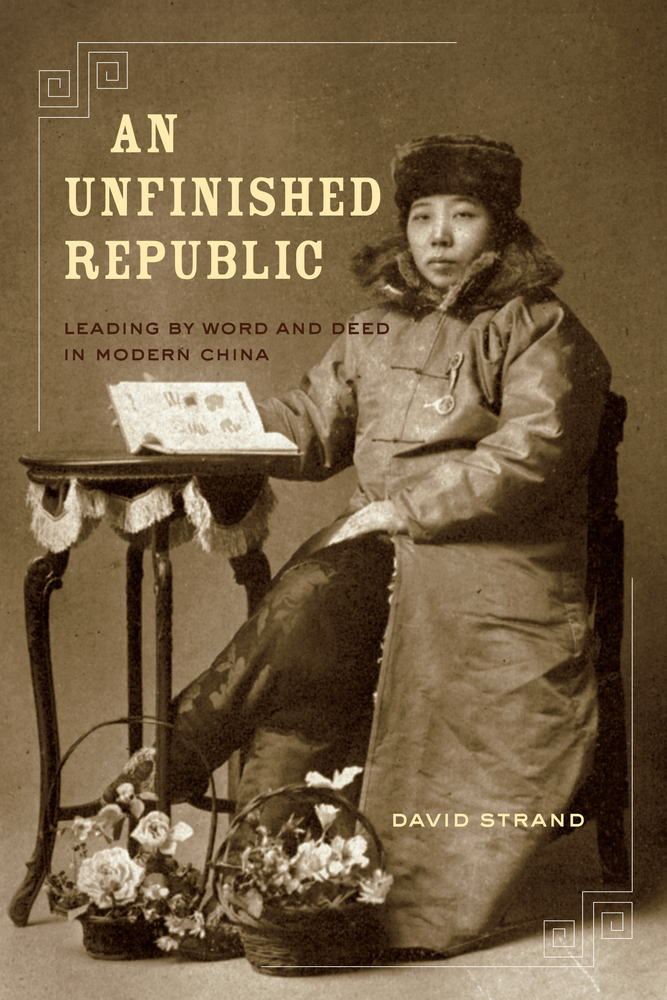
from the An unfinished republic (China 1912)

Found this most interesting – An Unfinished Republic by David Strand. As usual details below plus an online chapter worth reading here.
In this cogent and insightful reading of China’s twentieth-century political culture, David Strand argues that the Chinese Revolution of 1911 engendered a new political life—one that began to free men and women from the inequality and hierarchy that formed the spine of China’s social and cultural order. 


Despite delays in bringing customs up-to-date and the ability to compartmentalize some changes, 1911-12 represented the end of an era in a deep and hard to plumb sense. Ancient institutions and time-honored customs began to disappear. A new political world opened up, though its dimensions and nature were less than clear as the weeks, months, and years passed. 
The founding of the Chinese Republic in Nanjing on January 1, 1912, the thirteenth day of the eleventh month by the old calendar and less than three months after the October 10, 1911, troop mutiny in Wuchang that triggered the revolution, was meant to signal a decisive political transformation. To underline its hope for a new era, the revolutionary government in Nanjing also adopted the Western calendar on the last day of December 1911 and set the first year of the Republic to begin on the first day of January, designated now as China's new New Year's Day and the year 4,609 since the reign of the Yellow Emperor. Thus 1912 would be the "First Year of the Republic" (Minguo yuan), 1913 Year Two, and so on. The people and their Republic would now reign and number the years as emperors had done within each dynasty.
Of all the bold proposals broached in 1912, deciding a new date and meaning for "Chinese New Year" just as Chinese families began to make traditional end of the lunar year preparations was among the most ambitious and overreaching. In their haste to be seen as victorious, the revolutionaries in Nanjing also declared China a republic before the Qing court accepted final defeat. As a result China for nearly a month and a half had both an emperor and a president, a state of dual sovereignty indicative of confusion that reigned more securely than any single ruler or chief executive.
Most Chinese did not even know the year in question was "1912." World travelers like Liang Qichao of course did. Liang began using the Western dating system during a voyage to Hawaii in 1899 in a conscious embrace of cosmopolitanism. The revolutionary Zhang Binglin knew it was 1912 too but adamantly opposed adopting the new calendar as part of his fierce defense of Chinese traditions. Any republic Zhang would support had to run on Chinese time. According to the old calendar, the first weeks of the Republic still lay within the third year of Emperor Puyi's Xuantong reign, the Xinhai year by heavenly stem and earthly branch. Accordingly, the more accurate, inclusive name for the "1911 Revolution" is the Chinese one: Xinhai Revolution (Xinhai geming). Xinhai was supposed to be the year of triumph that Gengshen, Jiashen, Jiawu, and Gengzi had not been.
Not surprisingly, New Year's Day in the first year of the Republic for all but the most observant republicans still took place on regular schedule and according to the traditional dating system on February 18, 1912. The inertial force of Chinese time made itself felt. A week after announcement of the switch in calendars, Nanjing notified government agencies that merchants would be allowed to keep to the old calendar until the end of the Xinhai year. Changsha held New Year festivities on January 1, 1912, with a military parade accompanied by waving of the five-color striped flag of the Republic that signified China's multiethnic identity (red for Han, yellow for Manchu, blue for Mongol, white for Tibetan, and black for Muslim), trumpet blowing, and mass singing by troops. However, the ceremonies in Changsha were inspired more by Sun Yat-sen's inauguration as president in Nanjing and news of battlefield victories than dedication to the new calendar. In his diary of his first year living in Beijing beginning in May 1912, Lu Xun recorded being among the celebrants on October 10, 1912, the first anniversary of the Wuchang Uprising, joining crowds on the grounds of the Altar of Agriculture on January 1, 1913, in honor of Republic Commemoration Day, taking a stroll on "Old Calendar New Year's Day" on February 6, and noting the passage of Unity Commemoration Day on February 12, established by Yuan Shikai to mark the anniversary of Puyi's abdication and the Qing dynasty's demise.
Chinese would keep two kinds of time: the lunar calendar of festivals and agricultural rhythms and the Western calendar of the global, common era. For the remainder of the 1910s Lu Xun occasionally neglected to note the arrival of October's Double Ten Day and usually ignored mention of the January 1 and February 12 holidays except as days off from his work as a Ministry of Education employee. He never failed to note the arrival of the lunar New Year. Two decades later the Nationalists would still be trying, with mixed success, to supersede what the government hopefully termed the "abolished calendar."