Search This Blog

Showing posts with label luck. Show all posts

Sunday, April 17, 2016

Limitless Changeable Changes - From Oasis to the Middle Earth

Change is everywhere in life — and in English. This changeable word has numerous senses, both as a noun and verb, and is a part of many common phrases, like "a change of heart." 
  
bit#tech1    Pace of changes YESTERYEAR  1984-2014

"Evolution of the Desk" is an initiative borne out of the Harvard Innovation Lab.  
Can you find on the screen at least these items?
  • A cluttered desk, The Macintosh Classic, corded phone, fax machine, globe, corkboard, Polaroid camera,

  • a rolodex, a file cabinet, a radio set.
 Vintage items featured in this video are authentic. And the sunglasses? How old were day???


the evolution of the desk by the harvard innovation lab from designboom on Vimeo.


How has your desk changed over the years? 

bit#tech2   SLOW changes.... 2007-2016 -OASIS Today


A history of the Amazon Kindle


KindleEvoFinal
Since Amazon's Kindle e-reader was first introduced in 2007, the device has undergone a series of design changes. We take a look back at the various generations Amazon's most iconic piece of hardware.Now that Amazon has officially unveiled its new Kindle Oasis, the world's most popular e-reader has transitioned into its eight generation.
With an ultra-lightweight design, plus an included charging cover that delivers months of battery life, the Kindle Oasis looks to be the most advanced e-reader Amazon has yet released.
Video: Check out our hands-on impressions of the Kindle Oasis
But the Kindle started life as a very different device. The original 2007 version, with its slanted keyboard and 6-inch screen, looks completely unrelated to the sleek Oasis model. As with all technology, it's taken some years to reach this point, with numerous design innovations and refinements being introduced over successive years.

The launch of the Kindle Oasis therefore gives us the opportunity to revisit the various stages of the Kindle's evolution. Let's take a look at what came before.
Read more at http://www.trustedreviews.com/opinions/a-history-of-the-amazon-kindle#cgvsM6z7AU7tlFj0.99


bit#3    Perspectie  changes.... in Old Grece
"Look, Luke, a lucky strike has changed our community," Diogenes said, trembling.

"Long shot, indeed! It wasn't  a streak of luck." said Heraclitus.
Heraclitus is famous for his insistence on ever-present change in the universe, as stated in the famous saying, "No man ever steps in the same river twice". Observing  opposites, such as living and dead, waking and sleeping, young and old, are connected by change. In the end, There is nothing permanent except change.


"Se vogliamo che tutto rimanga come รจ, bisogna che tutto cambi""  -   in The Leopard         (G. Lampedusa)

"Be willing to surrender what you are for what you could become" - Reinhold Niebuhr.


Now from papers to media:
bit#4  media    Fiction and changes.... in the Middle Earth

The lord of the rings gives us the words and the swords to grasp our fickle life and myth, surrended by legends. Behind them the naked truth of our reality gloams with the daring forces of good and evil.


As unpredictable as the weather 
in the foggy, muggy kingdoms of the Middle Earth, 
we approach this candle-lit, unsteady world in the twilight with our favourite quote page at www.hark.com  


The world is changed. I feel it in the water. I feel it in the earth. I smell it in the air. Much that once was, is lost. For none now live who remember it. 

It began with the forging of the Great Rings. Three were given to the Elves... immortal, wisest, and fairest of all beings. Seven to the Dwarf-lords... great miners and craftsmen of the mountain halls. And nine. Nine rings were gifted to the race of Men, who, above all else, desire power. 
For within these rings was bound the strength and will to govern each race. But they were, all of them, deceived, for another ring was made. In the land of Mordor in the fires of Mount Doom, the Dark Lord Sauron forged, in secret, a Master Ring to control all others. And into this Ring he poured his cruelty, his malice, and his will to dominate all life. One Ring to rule them all.

Saturday, April 14, 2012

hard to believe: he did it twice

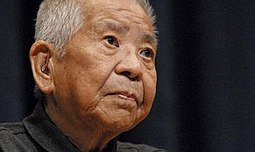
In the August of 1945, two atomic bombs were dropped in Japan August 6th in Hiroshima, 9th in Nagasaki. The total of 210,000 were killed. There were victims who were effected by both of the bombings. 

Remarkably, a group of perhaps 200 Japanese were present for both atomic bombings. 
However, he also suffered through the deaths of his wife and son from the after-effects of the bombings.
Yamaguchi (Guardian news), who is the only hibakusha (atomic bomb survivor) to be recognized by the Japanese Government for having suffered through both bombings, testified before the United Nations to advocate against the use of nuclear arms or even nuclear power. "The bottom line is, there shouldn't be nuclear in our world," he stated.
He also explained that his motto is "One for All, All for One" and felt he had done his duty when he extracted a commitment from famed movie director James Cameron to create a feature film about the atomic bomb survivors.

  Early life
Yamaguchi "never thought Japan should start a war". He continued his work with Mitsubishi Heavy Industries. As the war ground on, so despondent was he over the state of the country that he considered killing his family with an overdose of sleeping pills in the event that Japan lost.

   Hiroshima bombing
Yamaguchi lived and worked in Nagasaki, but in the summer of 1945 he went to Hiroshima for a three month business trip. On August 6, he was preparing to leave the city with two colleagues, Akira Iwanaga and Kuniyoshi Sato, and was on his way to the station when he realised he had forgotten soothing, and returned to his workplace to get it. At 8:15, he was walking back towards the docks when the Americans dropped the first atomic bomb to citizens ever near the centre of the city, only 3 km away. Yamaguchi recalls seeing the bomber and two small parachutes, before there was "a great flash in the sky, and I was blown over". The explosion ruptured his eardrums, blinded him temporarily, and left him with serious burns over the left side of the top half of his body. After recovering, he crawled to a shelter, and having rested, he set out to find his colleagues. They had also survived and together they spent the night in a refuge before returning to Nagasaki the following day. In Nagasaki, he received treatment for his wounds, and despite being heavily bandaged, he reported for work on August 9.

   Nagasaki bombing
At 11 am on August 9, Yamaguchi was describing the blast in Hiroshima to his supervisor, when the American bomber  dropped another  atomic bomb onto Nagasaki. His workplace again put him 3 km from ground zero, but this time, he was unhurt by the explosion.However, he was unable to seek replacement for his now ruined bandages, and he suffered from a high fever for over a week.

   Later life
After the war, Yamaguchi worked as a translator for the occupying American forces and then became a schoolmaster. When the Japanese government officially recognized atomic bombing survivors as hibakusha in 1957, Yamaguchi's identification stated only that he had been present at Nagasaki. It entitled him and other 260,000 survivors to monthly allowances, free medical dheckups and funeral expenses.
Yamaguchi was content with this, satisfied that he was relatively healthy, and put the experiences behind him.As he grew older, his opinions about the use of atomic weapons began to change.


Tsutomu Yamaguchi is one of those 200 or so people who were bombed twice, and survived twice. His hope towards the abolition of nuclear bombs brought 90-year-old Yamaguchi to make his appearance on this film. Along with Yamaguchi, seven other twice-bombed twice-survived people talk about their experience.

August 6th and August 9th are days to contemplate the awful possibilities of mankind, and resolve ourselves to do better.  Pandora's box of horrors was smashed on these days, and again many times in our gruesome history of war this last century

Violet Constance Jessop: the luck of the Irish nurse

One of the most amazing stories of any nautical  survivors:  Violet Constance Jessop. It could have been worse!

She managed to get through three whipwrecks, where she was working as a nurse:
1911 with the RMS Olympic
1912 with the RMS Titanic
1916  with the His Majesty’s Hospital Ship Britannic
If her parent had been middle class, they wouldn't have emigrated.
If she hadn't had tuberculosis, her doctors wouldn't been worried for her life.
If her 3 brothers had survived, her childhood would have been happier.
If her father hadn't died, she wouldn't have gone to London.

If she hadn't collided with another ship, her Olympic ship wouldn't  have sank. 
If she hadn't stroke a deathly icetrap, her Titanic voyage wouldn't  have ended in tragedy. 
If she hadn't stroke hit a mine, the Britannic  wouldn't  have sank. 


To read more: 
Her life had not been easy. Born to Irish emigrants living near Bahia Blanca, Argentina, Violet was the first of nine children, six of whom survived. Violet herself almost died after contracting tuberculosis at an early age and survived despite doctor’s predictions. After her father died, Violet and her family moved to Great Britain where she attended school.
1911 with the RMS Olympic when it nearly sank after colliding with the naval cruise the HMS Hawke (see picture). On the bridge during this incident was Captain Edward J.Smith.

1912 with the RMS Titanic (you already know the ending, but you perhaps forgot that E. J. Smith was its captain). After watching people being loaded into the lifeboats, she was ordered into lifeboat 16 and as the boat was being lowered, she was given a baby to look after. According to Jessop, while she was aboard the Carpathia, a woman grabbed the baby she was holding and ran off without saying a word.

When the Britannic struck a mine and sank in the Greek waters. While the ship was sinking  she jumped out of a

lifeboat in order to avoid being sucked into the Britannic’s propellers. She was sucked underwater and struck her head on the ship’s keel before being rescued by another lifeboat. 


Britannic sinks after hitting a mine as depicted in the film 


EPILOGUE: to be contrasted with Yamaguchi whose atomic mishap penetrated flesh and bones entirely.


One of the most amazing stories of any Titanic survivors, Violet Constance Jessop was an ocean liner stewardess and a nurse.   According to Violet, she made sure to grab her toothbrush before leaving her cabin on the Britannic and saying that it was the one thing she missed  most immediately after following the sinking of the Titanic.