Search This Blog

Sunday, November 6, 2011

East goes west: the slowly abolished old calendar in China... in 1912

from the An unfinished republic (China 1912)

Found this most interesting – An Unfinished Republic by David Strand. As usual details below plus an online chapter worth reading here.
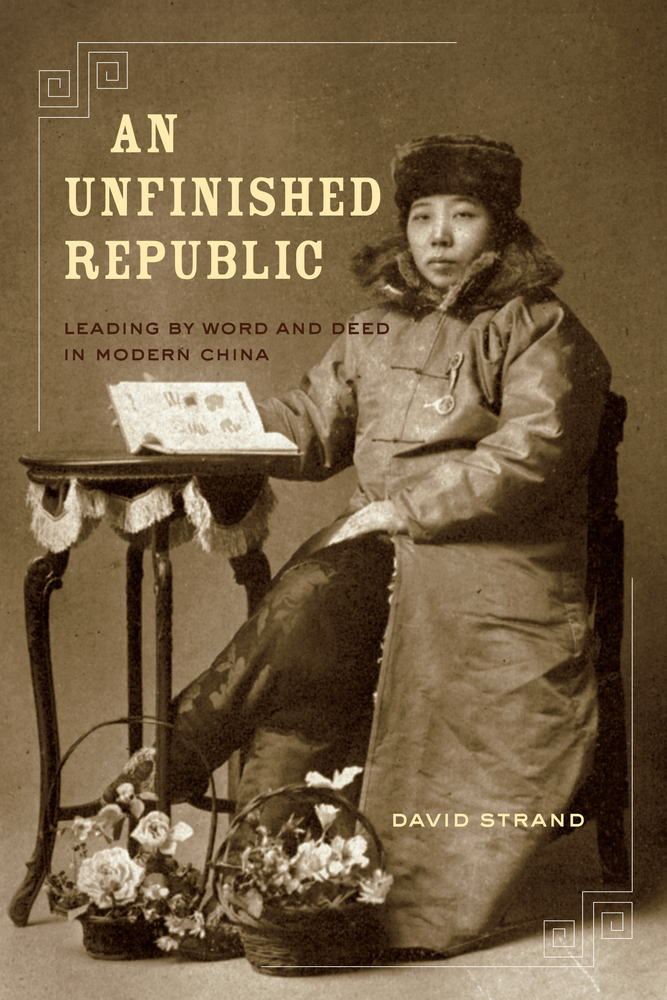
In this cogent and insightful reading of China’s twentieth-century political culture, David Strand argues that the Chinese Revolution of 1911 engendered a new political life—one that began to free men and women from the inequality and hierarchy that formed the spine of China’s social and cultural order. 


Despite delays in bringing customs up-to-date and the ability to compartmentalize some changes, 1911-12 represented the end of an era in a deep and hard to plumb sense. Ancient institutions and time-honored customs began to disappear. A new political world opened up, though its dimensions and nature were less than clear as the weeks, months, and years passed. 
The founding of the Chinese Republic in Nanjing on January 1, 1912, the thirteenth day of the eleventh month by the old calendar and less than three months after the October 10, 1911, troop mutiny in Wuchang that triggered the revolution, was meant to signal a decisive political transformation. To underline its hope for a new era, the revolutionary government in Nanjing also adopted the Western calendar on the last day of December 1911 and set the first year of the Republic to begin on the first day of January, designated now as China's new New Year's Day and the year 4,609 since the reign of the Yellow Emperor. Thus 1912 would be the "First Year of the Republic" (Minguo yuan), 1913 Year Two, and so on. The people and their Republic would now reign and number the years as emperors had done within each dynasty.
Of all the bold proposals broached in 1912, deciding a new date and meaning for "Chinese New Year" just as Chinese families began to make traditional end of the lunar year preparations was among the most ambitious and overreaching. In their haste to be seen as victorious, the revolutionaries in Nanjing also declared China a republic before the Qing court accepted final defeat. As a result China for nearly a month and a half had both an emperor and a president, a state of dual sovereignty indicative of confusion that reigned more securely than any single ruler or chief executive.
Most Chinese did not even know the year in question was "1912." World travelers like Liang Qichao of course did. Liang began using the Western dating system during a voyage to Hawaii in 1899 in a conscious embrace of cosmopolitanism. The revolutionary Zhang Binglin knew it was 1912 too but adamantly opposed adopting the new calendar as part of his fierce defense of Chinese traditions. Any republic Zhang would support had to run on Chinese time. According to the old calendar, the first weeks of the Republic still lay within the third year of Emperor Puyi's Xuantong reign, the Xinhai year by heavenly stem and earthly branch. Accordingly, the more accurate, inclusive name for the "1911 Revolution" is the Chinese one: Xinhai Revolution (Xinhai geming). Xinhai was supposed to be the year of triumph that Gengshen, Jiashen, Jiawu, and Gengzi had not been.
Not surprisingly, New Year's Day in the first year of the Republic for all but the most observant republicans still took place on regular schedule and according to the traditional dating system on February 18, 1912. The inertial force of Chinese time made itself felt. A week after announcement of the switch in calendars, Nanjing notified government agencies that merchants would be allowed to keep to the old calendar until the end of the Xinhai year. Changsha held New Year festivities on January 1, 1912, with a military parade accompanied by waving of the five-color striped flag of the Republic that signified China's multiethnic identity (red for Han, yellow for Manchu, blue for Mongol, white for Tibetan, and black for Muslim), trumpet blowing, and mass singing by troops. However, the ceremonies in Changsha were inspired more by Sun Yat-sen's inauguration as president in Nanjing and news of battlefield victories than dedication to the new calendar. In his diary of his first year living in Beijing beginning in May 1912, Lu Xun recorded being among the celebrants on October 10, 1912, the first anniversary of the Wuchang Uprising, joining crowds on the grounds of the Altar of Agriculture on January 1, 1913, in honor of Republic Commemoration Day, taking a stroll on "Old Calendar New Year's Day" on February 6, and noting the passage of Unity Commemoration Day on February 12, established by Yuan Shikai to mark the anniversary of Puyi's abdication and the Qing dynasty's demise.
Chinese would keep two kinds of time: the lunar calendar of festivals and agricultural rhythms and the Western calendar of the global, common era. For the remainder of the 1910s Lu Xun occasionally neglected to note the arrival of October's Double Ten Day and usually ignored mention of the January 1 and February 12 holidays except as days off from his work as a Ministry of Education employee. He never failed to note the arrival of the lunar New Year. Two decades later the Nationalists would still be trying, with mixed success, to supersede what the government hopefully termed the "abolished calendar."

Saturday, November 5, 2011

football in old england

At the time of the bloody  battles of Sluys (1340) and Crécy (1346), 
where the archers played their role and 15.000 Frenchmen were killed (in each!), no prisoners and where the fish -or the worms- could have learnt French, and that determined that Calais was taken in 1447 given control of the Channel- until 1557 (the first English colony)
competitions were ordered by Edward III to be held throughout the country.
 In a Close Roll, dated 1363, Edward orders the sheriff of Kent to 
"cause to be proclaimed that everyone in the shire, on festival days when he has holiday, shall learn and exercise himself in the art of archery, and use for his games bows and arrows, or crossbolts or bolts, forbidding all and single, on our orders, to meddle or toy in any way with these games of throwing stones, wood, or iron, playing handball, football, 'stickball,' or hockey, or cock-fighting, or any other games of this kind, which are worthless, under pain of imprisonment."37 


Interestingly, the only games (other than wrestling) played ...


 In 1363 Edward III, was obliged to issue a royal order forbidding many rural sports 
and enjoining the use of archery. His letter to the sheriff of Kent, dated 
June 1, 1363, ordered the sheriff to cause it to be proclaimed that:
on holidays every able-bodied man should use bows and arrows, oellets or bolts and practice the art of shooting "forbidding all and singular on pain of imprisonment to attend or meddle with hurling of stones, loggats or quoits, handball, football, club ball..., cock-fighting or other vain games of no value. The art of archery is almost wholly disused, whereby the realm is like to be kept without archers." bolts and practice the art of shooting "forbidding all and singular on pain of imprisonment to attend or meddle with hurling of stones, loggats or quoits, handball, football, club ball..., cock-fighting or other vain games of no value. The art of archery is almost wholly disused, whereby the realm is like to be kept without archers."
In 1565, Edward, still dissatisfied v/ith the situation, issu

Thursday, November 3, 2011

all the story of that little girl and the wolf

The Little Girl and the Wolf

Story tellers may: 
  • shorten the story
  • tell it in a different style of language
  • leave out the bloodthirsty bits
  • shift the setting/timeline
  • change the characters behaviour 

The story-telling needs a textual time background
  • Once upon a time/ Long time ago....
  • One day she set out....
  • Then, ...//After that ...
  • afterwards, // Later on
  • When somebody did sth, ...
  • Suddenly ...
  • As time went by, 
  • ... lived happily ever after.
Here you will find some variations to our fab fairy fable. 'Nuff said!
1. The latest I read, Roal Dahl's Perverting Rhymes chapter 5 (listen -or read- to it here, in the Poetry archive). He made up the classic tale. The wolf enters the grandmother's house and devours her before putting on her clothes in order to eat Little Red Riding Hood next. Riding Hood is not disturbed however, and calmly acts: 
"The small girl smiles/Her eyelid flickers/She whips a pistol from her knickers/She aims it at the creature's head and BANG! BANG! BANG! she shoots him ... dead.") 

2. LRRH by James Thurber (1939)One afternoon a big wolf waited in a dark forest for a little girl to come along carrying a basket of food to her grandmother. Finally a little girl did come along and she was carrying a basket of food. "Are you carrying that basket to your grandmother?" asked the wolf. The little girl said yes, she was. So the wolf asked her where her grandmother lived and the little girl told him and he disappeared into the wood.
When the little girl opened the door of her grandmother's house she saw that there was somebody in bed with a nightcap and nightgown on. She had approached no nearer than twenty-five feet from the bed when she saw that it was not her grandmother but the wolf, for even in a nightcap a wolf does not look any more like your grandmother than the Metro-Goldwyn lion looks like Calvin Coolidge. So the little girl took an automatic out of her basket and shot the wolf dead.
(Moral: It is not so easy to fool little girls nowadays as it used to be.)


Although I prefer the short "streetwise" version I read somewhere, some decades ago. Later on, I learned it was really just an earthy extrapolation of a retelling by famed humorist James Thurber glued above. Here is the "urban" version ending:
"Aha! Little Red Riding Hood!" cried the Wolf, happening upon the girl in the woods. "Now I'm going to take off your little red cape, lift up your little red skirt, pull down your little red underwear and burst your little brains out!" [We used to speak more direct language.]"Oh no you're not, Mr. Wolf!" the smirking Red Riding Hood replied, slowly pulling a gun out of her basket and pointing it at the wolf. "You're going to eat me - just like it says in the book!"

for a Politically correct version, read here)


Ladle Rat Rotten Hut  (click to Listen)
and the dangers of Spanglish intonation..
The story of Little Red Riding Hood as you've never heard it told before. Sit back and enjoy this story as told by master story teller, Paul Lantz in a way that will captivate kids from 2 to 102.
Once upon a time there was a girl who lived with her mother in a little cottage...
Since I know the story my brain almost automatically interprets the "nonsense words" as the "correct" ones - at points it just sounds like a very strange accent of English. But if you try....
Wants pawn term, dare worsted ladle gull hoe lift wetter murder inner ladle cordage, honor itch offer lodge dock florist. Disk ladle gull orphan worry ladle cluck wetter putty ladle rat hut, an fur disk raisin pimple colder Ladle Rat Rotten Hut. Wan moaning, Rat Rotten Hut's murder colder inset, "Ladle Rat Rotten Hut, heresy ladle basking winsome burden barter an shirker cockles. Tick disk ladle basking tutor cordage offer groin-murder hoe lifts honor udder site offer florist. Shaker lake! Dun stopper laundry wrote! An yonder nor sorghum-stenches, dun stopper torque wet strainers!""Hoe-cake, murder," resplendent Ladle Rat Rotten Hut, an tickle ladle basking an stuttered oft. Honor wrote tutor cordage offer groin-murder, Ladle Rat Rotten Hut mitten anomalous woof. "Wail, wail, wail!" set disk wicket woof, "Evanescent Ladle Rat Rotten Hut! Wares are putty ladle gull goring wizard ladle basking?""Armor goring tumor groin-murder's," reprisal ladle gull. "Grammar's seeking bet. Armor ticking arson burden barter an shirker cockles."
"O hoe! Heifer blessing woke," setter wicket woof, butter taught tomb shelf, "Oil tickle shirt court tutor cordage offer groin-murder. Oil ketchup wetter letter, an den - O bore!"Soda wicket woof tucker shirt court, an whinney retched a cordage offer groin-murder, picked inner widow, an sore debtor pore oil worming worse lion inner bet. Inner flesh, disk abdominal woof lipped honor bet an at a rope. Den knee poled honor groin-murder's nut cup an gnat-gun, any curdled dope inner bet.Inner ladle wile, Ladle Rat Rotten Hut a raft attar cordage, an ranker dough belle. "Comb ink, sweat hard," setter wicket woof, disgracing is verse. Ladle Rat Rotten Hut entity bet rum an stud buyer groin-murder's bet."O Grammar!" crater ladle gull, "Wood bag icer gut! A nervous sausage bag ice!""Battered lucky chew whiff, doling," whiskered disk ratchet woof, wetter wicket small."O Grammar, water bag noise! A nervous sore suture anomolous prognosis!""Battered small your whiff," insert a woof, ants mouse worse waddling."O Grammar, water bag mousy gut! A nervous sore suture bag mouse!"Daze worry on-forger-nut gulls lest warts. Oil offer sodden, thoroughing offer carvers an sprinkling otter bet, disk curl and bloat-thursday woof ceased pore Ladle Rat Rotten Hut an garbled erupt.Mural: Yonder nor sorghum stenches shut ladle gulls stopper torque wet strainers. 
wikipedia
The History of Ladle Rat Rotten Hut
As printed in The Next Whole Earth Catalog (circa 1980)

"Ladle Rat Rotten Hut" is often attributed to Anonymous, but it was actually written by H. L. Chase. He was a professor of French at Miami University in Oxford, Ohio, retired in 1965, and now is living in Cincinnati. He is in his eighties. I talked to him by phone about the story of the story.
"I wrote it about 1940. It was going to be part of a little article I was writing. It was in the days of rationing during the war and I thought about what would happen if we had to ration language. If our vocabulary were cut in half, we'd have to get along with other words. Consequently, I thought I'd see how you'd get along with the other half. I've never written that article, but I've always thought of doing it.
"I taught French, and I used the story in my class to show the importance of intonation in learning a foreign language. You see, if you take these English words and put them in columns like a spelling book and just read them, they have no meaning. However, if you read them with the proper intonation, the meaning appears for certain people. For other people the meaning never does appear.
"I never submitted it to anybody, but it got spread some way or other. It's one of those things that got completely out of control. I showed it to a few friends and to a book salesman who came to see me. He liked the thing because it had to do with words. I think I may have given him a copy, and he must have given it to someone else. It first appeared in print in the Merriam Company's magazine Word Study. I think it got in Stars and Stripes (U.S. Army newspaper) because I heard from people in Baghdad, Sweden, all over the world. Sports Illustrated found it in another publication and gave me $1000 for it. Arthur Godfrey found it in Sports Illustrated, and he broadcast it and very generously told any readers that wanted a copy they could have one by sending me postage. To my surprise, I mailed about five thousand of them. After that episode, Prentice Hall asked me to write a series of stories for a book, which I did. (Anguish Languish was published by Prentice Hall in 1955.)
"The book sold fairly well for that sort of thing. It went through four printings I think, maybe 14,000 copies total.
"It's used now a good deal in textbooks to demonstrate the phonetic structures of English. The book has been used by some psychologist to determine the ability of people to understand sound, to study the limit of distortion that can be comprehended. That varies from person to person.
"People who like it best are language people, teachers, lawyers, and doctors. That's almost all the people who are interested in it. And children, strange to say. I've had a lot of letters from them."
I asked him if it bothered him that it is often printed without his name. He said, "Well, it doesn't bother me, but it's just that if I had a cent for every Xerox copy, I'd be much better off because I know it's been copied by the thousands."
The book, Anguish Languish, is out of print and very hard to find. Chase himself only has one copy. Dover or somebody should reprint it.
-Anne Herbert

Wednesday, November 2, 2011

no fairy tales -stories from the unemployed

unemployed, with 4 stories -the guardian

As usual, the protesters’ signs tell the story – none more so than the one that says, “A job is a right. Capitalism doesn’t work.”
I don't want to be on benefits for the rest of my life'  Taylah-Nicole Douglas, 17, south London
I've been unemployed my whole life. I did one year at college, but I dropped out six months ago because I live on my own in a hostel, so I need to work. I wasn't making any money at college, EMA [Education Maintenance Allowance] wasn't enough, and things would have got a lot worse after it was cut. I was struggling, so I realised I had to find work.
The problem is, I can't find any. I've only got three or four GCSEs. So I apply for a job, they say they'll get back to me, and they almost never do. I've made 50 applications in six months, through Jobcentres, and on the internet. But I've only heard back from about five, saying: "Sorry, you haven't been successful." I haven't had any interviews. There was one for a chugging [street fundraising for charity] job, but it turned out it was on the other side of London, and so I would have spent more money on travel getting there and back than I would be earning.
I don't think I have any friends who have a full-time job. This year, half of my class – seven or eight of us – dropped out of college. I think one person out of eight now works in Topshop part-time. The Jobcentre say there's no jobs going. They say it's better for me to stay on benefits for the moment. And that makes me feel like rubbish. I want to work. I would work if I had the chance to. I do a lot of writing, so, ideally, I'd like to do something media-based. I don't want to be on benefits for the rest of my life.

 STORY 2. 'After rent I've only got £30 to live off for two weeks'

Ria Shaquan Dwyer, 17, south London

I started writing for a youth magazine called Live. I've also done some work experience on fashion shoots. But I really need more than just work experience – I need to be paid. I live alone in a hostel, which costs £55 every two weeks. I get benefits, but after I pay my rent, I've only got £30 to live off for two weeks.
I've never actually had a job. It's hard because I don't have any GCSEs. I'm going for anything, though. I've made uncountable applications – at least 200. But you never get an email, you never get a phonecall. It gets to the point where I think, I'm going to give up. But then I remember if I give up, I'm not actually going to get a job. So I keep on going.
Employers need to start taking on people who may not have the right qualifications, but can still do the job. Look at me: I can speak perfect English. I can read and write, but I didn't go to school. And because I don't have English and maths GCSEs, I'm labelled dumb. And actually, I'm not dumb.


'I'm moving back with my parents to help look after me'
Lizzie Polack, 23, York

I have spent most of the summer applying for jobs, mainly in admin because I have experience in that, having worked for my university accommodation office. I did a biology degree, and then a diplomacy masters degree, and I would like to go into international relations, but those kind of jobs require internships which I can't afford to do.
My idea was to do an admin job for a couple of years and save some cash, but the problem is when you apply for an admin job they all wonder why you're not applying for a politics job.
If I got a job where there was career progression I can see myself doing it for an extended period but it's just getting my foot on the block. At one interview, they said: 'You're obviously academic, why do you want this job?' It's frustrating when they say they don't think a job is good enough for you.
I'm moving back with my parents and they're going to help with looking after me, but I don't want to be a burden on them. I'm old enough to get a job and it's pathetic that I can't. I've never had any experience of working in  a bar or restaurant but when I move out of home I'm going to try and get anything I can. It's not what I was hoping for but any job is better than no job.

'The last time I had a proper job was five years ago'
Lydia Marmorstein, 24, north London

The last time I had a proper job was in June 2006, when I was a filing clerk for a chartered accountant. I suffer from chronic fatigue, so I only lasted a month before they fired me. My illness means I'm more tired than most people, and I'm in a lot of pain. As a result, I couldn't work straight through the day, and I had to take a lot of breaks. And so they asked me to leave.
Since then, I've been focusing on recovery. I've volunteered in charity shops, and tried sending off my CV to 30 different employers — but I've only had around two interviews. I've also just started a part-time course at Birkbeck.
I noticed that many jobs don't pay very much, but increasingly look for a lot in their employees. They might look for graduates, but not actually pay a graduate salary. They want people to be available all the time, to change shifts at short notice, and to come in at weekends and evenings. That's a tall order at £6-£7 an hour.
I worry because while there's all this unemployment, and it's rising, they're also trying to cut benefits. What are all these people, including me, going to live on if all these benefits keep going down? They're already pretty low, and they're already hard to live off.

Tuesday, November 1, 2011

corpus and browse

http://aggslanguage.wordpress.com/2011/10/30/is-proper-english-dying-and-should-us-care/

videos showing Siri confounded by foreign accents have gone viral, most notably one shared by Hidenori Satoh, a Japanese journalist present at the iPhone 4S’s Tokyo unveiling. Siri is currently optimized for standard U.S., U.K. and Australian English dialects and, notes Apple, its “suitability rate will be higher for native speakers.”
Does this suggest a future in which non-native English speakers might end up with their homes and devices in Hal 2000-like rebellion, unwilling or unable to respond to their commands?

 it is true that belief in female loquacity is generally combined with disapproval of it. The statement “women talk more than men” tends to imply the judgment “women talk too much”. (As one old proverb charmingly puts it: “Many women, many words; many geese, many turds.”)


Browse Word Lists

Browse our collection of word lists which allow you to examine words more closely. Provides descriptions of words alongside dictionary definitions and a list of related words.

Gie us an aw day tae the toon and accents with SIRI -apple's assistent

According to an interview I heard a couple of years ago on the CBC, businesspeople using standard English sometimes need and interpreter when in Glasgow.
He added: "We're not necessarily looking for people who are particularly skilled in linguistics, just candidates who can help out clients who may struggle with native Glaswegian."
James Lillis said: "When new employees come to Scotland and hear the Glasgow accent, it can be a problem. Drivers have to learn to understand what is meant when a customer says, for example, 'Gie us an aw day tae the toon' (Give me an all day ticket to the town)."

I'm glad this came up - I heard the news earlier on the BBC. I imagine most Scots will be having a wry chuckle to themselves about it, like myself.
The problem is nothing new, as we can see from the Burnistoun lift sketch below:
[Iain] Where's the buttons?
[Rob] Oh no, they've installed voice-recognition technology in this lift, they have no buttons.
[Iain] Voice-recognition technology? In a lift? In Scotland? You ever tried voice-recognition technology?
[Rob] No.
[Iain] They don't do Scottish accents.
[Rob] Eleven.
[VOICE] Could you please repeat that?
[Iain] Eleven.
[Rob] Eleven. Eleven.
[Iain] Eleven.
[VOICE] Could you please repeat that?
[Rob] EL-EV-EN.
[Iain] Whose idea was this? You need to try an American accent. "E-leven. E-leven."
[Rob] That sounds Irish, not American.
[Iain] No it doesn't! ELEVEN.
[Rob] Where in America is that - Dublin?
[VOICE] I'm sorry. Could you please repeat that?
[Rob] Try an English accent. "Eelevin! Eelevin!"
[Iain] You from the same part of England as Dick van Dyke?
[Rob] Let's hear yours then, smartass.
[VOICE] Please speak slowly and clearly.
[Rob] SMARTASS.
[Iain] Ee-lev-en.
[VOICE] I'm sorry. Could you please repeat that?
[Iain] ELEVEN. If you don't understand the lingo, away back home to your own country!
[Rob] Ooo, it's that talk now, is it, away back home to your own country?
[Iain] Oh, don't start Mr. Bleeding Heart, how can you be racist to a lift?
[VOICE] Please speak slowly and clearly.
[Rob] Eleven. Eleven. Eleven. Eleven.
[Iain] You're just saying it the same way!
[Rob] I'm going to keep saying it until it understands Scottish, alright?
[Rob] Eleven. Eleven. Eleven! Eleven!
[Iain] Oh just take us anywhere, ya cow! Just open the doors!
[VOICE] This is a voice-activated elevator. Please state which floor you would like to go to in a clear and calm manner.
[Iain] Calm? Calm? Where's that coming from? Why is it telling people to be calm?
[Rob] Because they knew they'd be selling this to Scottish people who'd be going off their nuts at it!
[VOICE] You have not selected a floor.
[Rob] Aye, we have! Eleven!
[VOICE] If you would like to get out of the elevator without selecting a floor, simply say "Open the doors, please".
[Iain] Please? Please?? Suck my wully.
[Rob] Maybe we should just say "please".
[Iain] I'm not begging that for nothing.
[Rob] Open the doors, please.
[Iain} "Please!" Pathetic.
[VOICE] Please remain calm.
[Rob] Oh! My! God! You wait until I get up there...just wait for it to speak...
[VOICE] You have not selected a floor.
[Rob] Up yours, ya cow! If you don't let us through these doors, I'm gonna come to America, I'm gonna find whatever desperate actress gave you a voice, and I'm gonna go to the electric chair for ye!
[Iain] Scotland, you bastard!
[Rob] Scotland!
[Iain] SCOTLAND!
[Rob] SCOOOOOTLAND!
[Iain] FREEDOM!!
[Rob] FREEDOM!!
[Iain] Goin' up?  
(source http://www.youtube.com/watch?v=5FFRoYhTJQQ)

It reminds me of this clip from Not The Nine O'Clock News, featuring the Big Yin and his future wife, Pamela Stephenson above!!!

Personally, I've always thought that there should be subtitles on UK TV for any programmes featuring Scottish accents......icon_wink.gif

Anyone care to enlighten me on the linguistic and social stratification of Glaswegian?