Life is .... a chaos between two silences (Beckett) ...
they lived und laughed ant loved end left (Joyce)
But A language is ... a dialect with a Department of Education and firm grasp of the curriculum.
ted talks: RORY SOUTHERLAND. Life lessons from an ad man
Video: (Buzzer) Man: Shreddies is supposed to be square.
Woman: Have any of these diamond shapes gone out?
Voiceover: New Diamond Shreddies cereal. Same 100 percent whole-grain wheat in a delicious diamond shape.
HHH
Man: So, Shreddies is actually producing a new product, which is something very exciting for them. So they are introducing new Diamond Shreddies. (Laughter) So I just want to get your first impressions when you see that, when you see the Diamond Shreddies box there.
Woman: Weren't they square?
Woman #2: I'm a little bit confused. Woman #3: They look like the squares to me.
Man: They -- Yeah, it's all in the appearance. But it's kind of like flipping a six or a nine like a six. If you flip it over it looks like a nine. But a six is very different from a nine.
Woman # 3: Or an "M" and a "W". Man: An "M" and a "W", exactly.
Man #2: [unclear] You just looked like you turned it on its end. But when you see it like that it's more interesting looking.
Man: Just try both of them. Take a square one there, first. (Laughter) Man: Which one did you prefer? Man #2: The first one.
Man: The first one?
produce placebo education. The point is that education doesn't actually work by teaching you things. It actually works by giving you the impression that you've had a very good education, which gives you an insane sense of unwarranted self confidence, which then makes you very, very successful in later life. So, welcome to Oxford, ladies and gentlemen. (Laughter)
from Rory Southerland
goods have become commoditized. Commoditized: where they're treated like a commodity, where people don't care who makes them. They just care about three things and three things only: price, price and price.
That's why you have companies like Starbucks, right, that doesn't advertise at all. They said, you want to know who we are, you have to come experience us. And think about the economic value they have provided by that experience. Right? Coffee, at its core, is what? Right? It's beans; right? It's coffee beans. You know how much coffee is worth, when treated as a commodity as a bean? Two or three cents per cup -- that's what coffee is worth. But grind it, roast it, package it, put it on a grocery store shelf, and now it'll cost five, 10, 15 cents, when you treat it as a good. Take that same good, and perform the service of actually brewing it for a customer, in a corner diner, in a bodega, a kiosk somewhere, you get 50 cents, maybe a buck per cup of coffee. But surround the brewing of that coffee with the ambiance of a Starbucks, with the authentic cedar that goes inside of there, and now, because of that authentic experience, you can charge two, three, four, five dollars for a cup of coffee. So, authenticity is becoming the new consumer sensibility.
Meat the future is a project that intends to inform people about todays
unsustainable and inhumane meat industry. But also give hope for a change as
there is a solution in sight, called In Vitro meat.
Meat produced in vitro has been proposed as a humane, safe
and environmentally beneficial alternative to slaughtered animal flesh as a
source of nutritional muscle tissue. The basic methodology of an in vitro meat production
system (IMPS) involves culturing muscle tissue in a liquid medium on a large
scale.
Industrial relevance: The development of an alternative meat
production system is driven by the growing demand for meat and the shrinking
resources available to produce it by current methods.
Isha Datar is the author of “Possibilities for an in vitro meat production system”, Canada’s only scientific investigation into cultured meat. Isha’s work has contributed to the development of Canada’s first in vitro meat lab at the University of Alberta, and has been featured in several articles in Canada and abroad. Her advocacy for the responsible use of science to contribute to food security has led to multiple speaking engagements on in vitro meat and agrobiotechnology patent reform.
Innovation in Education (August 2010). Get the word out
Spreading the word about the Khan Academy is one of the best ways to help us. Each month we serve over 1,000,000 students, but there's no reason it shouldn't be 20 million. Please take a moment to share this site with your friends and community.
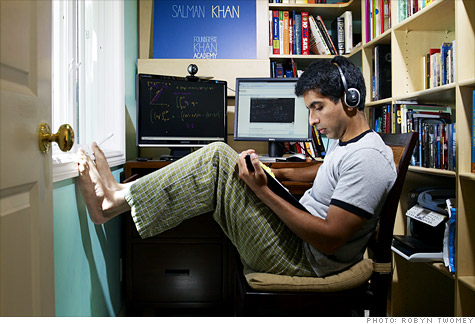
(news) FORTUNE -- Sal Khan, you can count Bill Gates as your newest fan. Gates is a voracious consumer of online education. This past spring a colleague at his small think tank, bgC3, e-mailed him about the nonprofitkhanacademy.org, a vast digital trove of free mini-lectures all narrated by Khan, an ebullient, articulate Harvard MBA and former hedge fund manager. Gates replied within minutes. "This guy is amazing," he wrote. "It is awesome how much he has done with very little in the way of resources." Gates and his 11-year-old son, Rory, began soaking up videos, from algebra to biology. Then, several weeks ago, at the Aspen Ideas Festival in front of 2,000 people, Gates gave the 33-year-old Khan a shout-out that any entrepreneur would kill for. Ruminating on what he called the "mind-blowing misallocation" of resources away from education, Gates touted the "unbelievable" 10- to 15-minute Khan Academy tutorials "I've been using with my kids." With admiration and surprise, the world's second-richest person noted that Khan "was a hedge fund guy making lots of money." Now, Gates said, "I'd say we've moved about 160 IQ points from the hedge fund category to the teaching-many-people-in-a-leveraged-way category. It was a good day his wife let him quit his job." Khan wasn't even there -- he learned of Gates' praise through a YouTube video. "It was really cool," Khan says
To speak the truth, extensive listening is far better than testing listening BUT listening and understanding is the best. As careless inkjet learners we need language information. Mind you, that is as good as it can get. For news with script click here Those are the links we can click for our videos with subtitles:
Firstly, TED talks. Here the interest must be content. Follow the talks you want to learn about. Choose the SPEAKERS / THEMES you want to follow. Features: 8000 talks with subtitles on screen and the bestest interactive script on the web (on the right side)
Secondly, Universalsubtitles, a project of Participatory Culture Foundation. A lovely opportunity to become a user of English in an open source project!!!!
Then, a couple of individual work on enjoyable video clips and sketches: Mingo Mendez (Catalonia). LiveScripts - Guiones. Life is the movie where we are the leading character while we write the script of the movie we would like to live or shoot.
and lst but not least, Mikesy András (Hungary) a creative teacher from CentreEurope who presents the History of the English!!! (you can miss it)
Hello. It's nice to see you all here. Now, as the most perceptive of you probably realized by now, this is Hell and I'm the Devil. Good Evening! But you can call me Toby if you like, we try to keep things informal in here as well as infernal. That's a little joke of mine; i tell it every time. Now you are all here for... Eternity, which I hardly need tell you it's a heck of a long time. So you'll all get to know each other pretty well by the end. But for now I'm gonna have to split you up into groups. Will you stop screaming? Thank you. (see all the piece at the link above)
4. Snappy Hamlet monologue: (Blackadder - Comedy) (script below from 2:10 to 3:25) All the piece transcript at Hamlet Sketch-small rewrite
(2:10) Blackadder: Bill, Bill, Bill... Why do we have to fight? It's long, long, long. We could make it so snappy... Shakespeare: "Snappy"?
B: Yeah, you know: give it some pizzazz. How's it begin, that speech?
Sh: [sits] "To be."
B: Come on, come on, Bill.
Sh: "To be a victim of all life's earthly woes, or not to be a coward and take Death by his proffered hand."
B: There, now; I'm sure we can get that down!
Sh: No! Absolutely not! It's perfect.
B: [preparing to write] How about "To be a victim, or not to be coward"?
Sh: [shrugs] It doesn't make sense, does it! To be a victim of what? to be coward about what?
B: OK, OK. Take out `victim'; take out `coward'. Just start "To be, or not to be."
Sh: You can't say that! It's gibberish!
B: But it's short, William, it's short! Listen, it flows: "To be, or not to be; that is the question." D'de, d'de de de, d'de d'de de de! OK?
Sh: You're damn right it's the question -- they won't have any bloody idea what he's talking about! (3:25)
When Pranav Mistry of MIT’s Media Lab showcased to the world his groundbreakingSixthSense technology, everyone said this was going to be the next big thing. It was the 2009Invention of the Yearand the most exciting part about it, it was going to be open source. With the code available to a whole community of hackers, we would see all sorts of interesting uses for the technology in no time. Three years later, no code, and no talk of SixthSense hitting the market any time soon.
Like so many great inventions, turning an idea into reality, especially into a ubiquitous reality, takes time and patience. Bringing the impressive fictional technology from Minority Report to our fingertips, Mistry found a way to bridge the gap between intangible digital information and the tangible world.
In case you’ve never heard of SixthSense, it essentially allows you to access information from the Internet and project that information on any surface, including your hand. It reads human gestures and turns any surface into an interactive screen. It senses objects around you, reads your hand gestures and immediately displays relevant information.
So let’s say you’re at the grocery store and want to find out more about a certain brand of cereal, SixthSense will display in real-time any additional information on the product you’re holding. Lost? Take a picture of your surroundings by forming a frame with your hands and locate yourself on Google Maps. Wondering what time it is? Draw a circle on your wrist and a holographic watch will appear with the precise time.
SixthSense turns the Internet into a sixth human sense.
Demo (2009):
Watch TedIndia Talk (2009):
The technology has progressed steadily since its inception. Evolving from an awkward helmet with a projector attached to it to a tiny depth-sensing camera, similar to the one used on Xbox’s Kinect, SixthSense has come a long way. But if you, like me, are squirming in the backseat asking “Are we there yet”, no… we still have a ways to go.
As Howard Rheingold himself puts it, "I fell into the computer realm from the typewriter dimension, then plugged my computer into my telephone and got sucked into the net." A writer and designer, he was among the first wave of creative thinkers who saw, in computers and then in the Internet, a way to form powerful new communities.
His 2002 book Smart Mobs, which presaged Web 2.0 in predicting collaborative ventures like Wikipedia, was the outgrowth of decades spent studying and living life online. An early and active member of the Well (he wrote about it in The Virtual Community), he went on to cofound HotWired and Electric Minds, two groundbreaking web communities, in the mid-1990s. Now active in Second Life, he teaches, writes and consults on social networking. His latest passion: teaching and workshoppingparticipatory media literacy, to make sure we all know how to read and make the new media that we're all creating together.
"With his last book, Smart Mobs, the longtime observer of technology trends made a persuasive case that pervasive mobile communications, combined with always-on Internet connections, will produce new kinds of ad-hoc social groups. Now, he's starting to take the leap beyond smart mobs, trying to weave some threads out of such seemingly disparate developments as Web logs, open-source software development, and Google."


 Download